
How to Start With Crypto if You Only Have $50–$200: What Actually Makes Sense

Yes, $50–$200 Is Enough to Start. Here’s Exactly What to Do With It.
You’ve been watching crypto for a while. You have $100, maybe $200. You’re not trying to get rich — you want to understand it, hold something real, and not make a stupid mistake with your first move.
The bad news: most beginner guides are written for people with $5,000. They tell you to “diversify your portfolio” when your budget is $150.
The good news: crypto investing with a small budget under $500 covers the bulk of beginners entering the market in 2026. The approach for $50–$200 is actually cleaner and lower-risk than for larger amounts — because it forces the right behavior: slow, simple, and focused on learning before earning.
Here’s exactly what makes sense at your budget — and what definitely doesn’t.
The Honest Reality of $50–$200 in Crypto
Before the specific steps, understand the math:
| Starting Amount | Realistic Use | What It Can’t Do |
|---|---|---|
| $50 | Buy a small amount of BTC or ETH. Learn the process. | Meaningful profit from price moves |
| $100 | Split BTC/ETH. Start a DCA habit. Understand fees. | Diversify into altcoins sensibly |
| $200 | 70/30 BTC/ETH split. One small altcoin position ($20–30). | Replace a proper emergency fund |
Transaction fees may eat into gains at this budget level — which is why choosing the right exchange is more important here than at $5,000.
The goal at this amount: Not profit. Understanding. You’re buying experience and education alongside the asset. Anyone telling you to chase 10× returns on $100 is selling something.
Step 1: Choose the Right Exchange (Fees Kill Small Accounts)

At $50–$200, fees matter more than at any other amount. A $2.99 fee on a $50 purchase is 6% gone immediately.
| Exchange | Minimum Buy | Fee on $100 Purchase | Best For |
|---|---|---|---|
| Coinbase | $2 | ~$2.99 (2.99%) | Absolute beginners, US |
| Kraken | $10 | ~$0.26 (0.26%) | Best fee structure, US |
| Gemini | $0.01 | ~$1.49 (ActiveTrader) | US, clean interface |
| Binance.US | $10 | ~$0.10 (0.10%) | Lowest fees, slightly complex |
Coinbase, Kraken, Gemini, and Binance.US lead the regulated US market in 2026.
For $50–$200: use Kraken or Binance.US. The fee difference sounds small — but on a $100 purchase, Coinbase’s $2.99 fee vs Kraken’s $0.26 is a 10× difference. Over a year of monthly $100 buys, that’s $32 saved.
Setup requirements for all of them: Government ID, a few minutes of identity verification (KYC). Not optional — regulated exchanges require it. Plan 10–20 minutes for account verification before you can buy anything.
Step 2: What to Actually Buy

With $50–$200, the answer is almost always the same: Bitcoin, Ethereum, or both.
Not because they’ll definitely go up. Because:
- Most liquid assets — easiest to sell when you need to
- Most regulated — ETFs exist for both now
- Most understood — you’ll find more information, analysis, and community
- Lowest risk of going to zero relative to the rest of the market
Recommended split by budget:
| Budget | Allocation | Reasoning |
|---|---|---|
| $50 | 100% BTC or ETH (pick one) | Too small to split sensibly after fees |
| $100 | 70% BTC / 30% ETH | Classic starter split, captures both ecosystems |
| $200 | 60% BTC / 30% ETH / 10% speculative | Room for one small alt position ($20) |
Start with BTC or ETH for stability, then add one layer-1 asset you’ve researched.
On altcoins with $50–$200: A $20 position in Solana or another layer-1 is fine if you’ve done real research. A $50 meme coin bet is not crypto investing — it’s gambling at unfavorable odds. The speculative slice of any small portfolio should never exceed 10 to 15 percent of total value.
Step 3: DCA — The Only Strategy That Makes Sense at This Amount
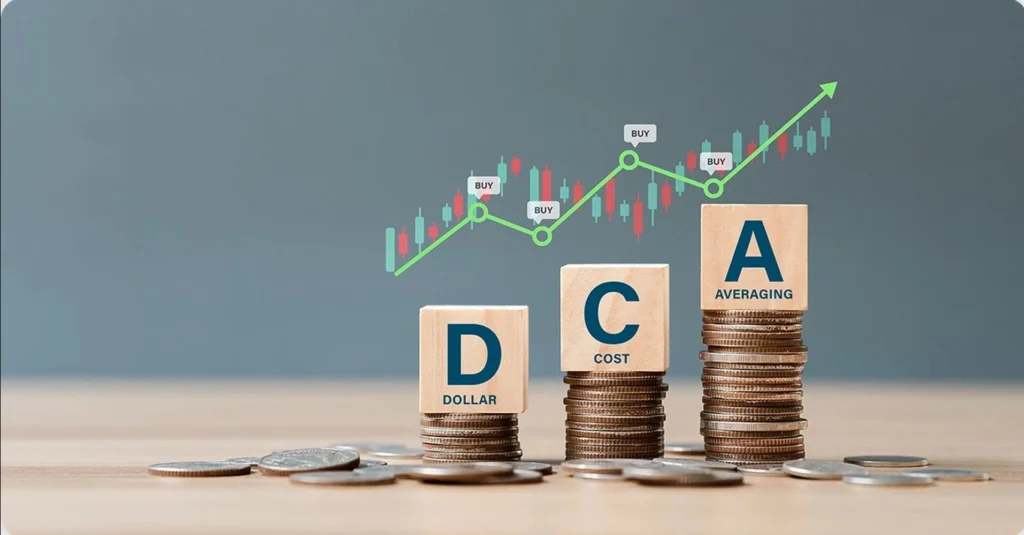
Dollar-Cost Averaging means investing a fixed amount on a regular schedule — $25/week or $50/month — regardless of price.
Why this beats “wait for the dip”:
- Nobody consistently times the market — not professionals, not influencers
- Removes emotional decision-making
- Works automatically on Coinbase, Kraken, and Gemini (set it once, runs itself)
One reliable method is Dollar-Cost Averaging — investing the same small amount regularly regardless of price. Over time, this smooths out volatility and prevents emotional decision-making.
Practical DCA at your budget:
| Weekly DCA | Monthly Total | 1 Year Total |
|---|---|---|
| $10/week | $40–43/month | ~$520 |
| $25/week | ~$100/month | ~$1,300 |
| $50/week | ~$200/month | ~$2,600 |
Set your DCA amount low enough that you can comfortably continue through any market condition. The amount that sticks for years matters far more than the amount that looks impressive on a spreadsheet for a few months.
Step 4: Where to Store It (The Part Most Guides Skip)
For $50–$200: keep it on the exchange. Yes, “not your keys, not your coins” is true — but a hardware wallet costs $79–$149, which is half your starting budget. The risk/cost math doesn’t work at this amount.
Upgrade plan as your holdings grow:
| Holdings Value | Storage Recommendation |
|---|---|
| Under $500 | Reputable regulated exchange (Coinbase, Kraken, Gemini) |
| $500–$2,000 | Consider a software wallet (MetaMask, Exodus) — free |
| Over $2,000 | Hardware wallet worth considering (Ledger, Trezor, ~$79–149) |
If you keep it on the exchange:
- Enable two-factor authentication (2FA) using an authenticator app — not SMS
- Use a unique email and password not used anywhere else
- Never share your account credentials with anyone
What NOT to Do With $50–$200

These are the mistakes that lose real people real money:
❌ Buying altcoins you heard about on social media At $50–$200, you have no margin for error. A meme coin that drops 90% turns $50 into $5.
❌ Using a leverage or margin product Leverage amplifies losses. A 2× leveraged ETH product on a 30% ETH drop = 60% loss. Not appropriate at any budget, especially not this one.
❌ Buying multiple small positions on Coinbase At their fee structure, buying 5 different assets at $20 each costs you ~$15 in fees. You’d need 75% returns just to break even on the fees.
❌ Treating this as an emergency fund Crypto can drop 50–80% in bear markets. Any money you might need in the next 12 months shouldn’t be in crypto. Most financial educators suggest keeping crypto between 1% and 5% of your investable assets.
❌ Checking the price multiple times per day Not because it’s unhealthy (though it can be) — because it generates emotional trading decisions that cost money. Set a schedule: check weekly.
The Actual Starting Checklist
- ✅ Open account on Kraken or Binance.US (lowest fees)
- ✅ Complete KYC verification (10–20 minutes, ID required)
- ✅ Enable 2FA using an authenticator app
- ✅ Deposit your starting amount
- ✅ Buy BTC (or 70/30 BTC/ETH split if over $100)
- ✅ Set up recurring DCA — weekly or monthly, amount you won’t miss
- ✅ Screenshot your purchase price and amount
- ✅ Check price weekly maximum for the first 3 months
- ✅ When holdings reach $500, consider a software wallet
- ✅ Don’t touch it for 12 months unless your life situation changes
FAQ
Q: Can you actually make money starting with $50 in crypto? Yes, but “making money” at $50 should not be the goal — learning is. If Bitcoin doubles (which it has done over multi-year periods), your $50 becomes $100. That’s meaningful proof-of-concept. It’s not life-changing money. The right frame: you’re buying education and exposure, not a lottery ticket.
Q: What’s the best crypto to buy with $100 for a beginner in 2026? Bitcoin (BTC) or Ethereum (ETH), or a 70/30 split between them. Both have spot ETFs now, regulated market infrastructure, and the deepest liquidity. At $100, you don’t have enough capital to justify the risk of anything else.
Q: Which exchange is best for $50–$200 starting amounts? Kraken for lowest fees in the US (0.26% per trade vs Coinbase’s 2.99%). Binance.US is even cheaper (0.10%) but slightly more complex for absolute beginners. Coinbase is easiest to use but most expensive — at small amounts, the fee difference matters significantly.
Q: What is DCA and why does everyone recommend it for beginners? Dollar-Cost Averaging: invest a fixed amount on a regular schedule (e.g., $25 every Monday) regardless of whether prices are up or down. It removes the impossible task of “timing the market” and smooths out volatility over time. At $50–$200, it also helps you build a habit without needing to predict anything.
Q: Do I need a hardware wallet for $50–$200? No. At this amount, keeping funds on a regulated exchange (Coinbase, Kraken, Gemini) with 2FA enabled is the right call. Hardware wallets cost $79–$149 — that’s up to 3× your starting amount. Revisit when your holdings exceed $500–$1,000.
Q: What happens if the exchange gets hacked and I lose everything? It’s a real risk. Use regulated, insured exchanges — Coinbase holds most USD funds under FDIC insurance and has crime insurance for digital assets. Kraken has never been successfully hacked. Gemini is SOC 2 certified. The risk is not zero but is manageable with the right exchange choice and 2FA enabled.
Crypto is highly volatile. You can lose everything you invest. Only use money you can afford to lose completely. This is not financial advice.
Clair et pratique. Essayez Happy Shrimp : /. Happy Shrimp