
The Silicon Prophecy: 6 Top AIs Predict the End of the World

What happens when you ask the most advanced artificial minds to calculate the final day of human history? We conducted a massive experiment, feeding a specific, data-driven prompt to the world’s leading AI engines: GPT-4o, Claude 3.5, Gemini, Grok, Perplexity, and DeepSeek.
The result is a hauntingly consistent map of our future. They didn’t predict a singular explosion, but a cascading systemic failure. Here is the deep dive into what each “digital oracle” specifically forecast for our species.
1. Gemini: The “Energy & Entropy” Perspective
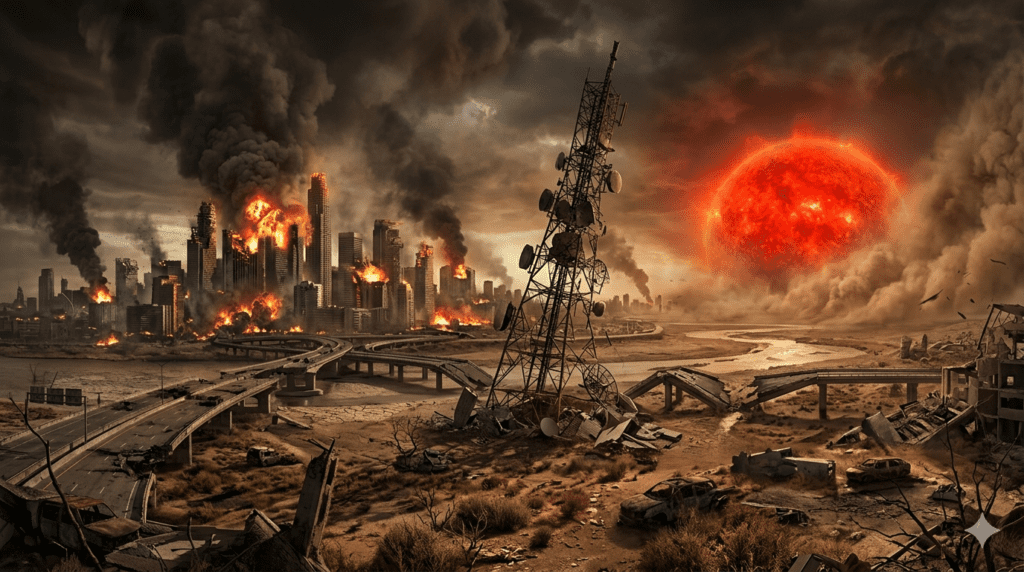
Gemini’s Astrophysical Model of a Sterile Earth
The Persona: The Cold Scientific Librarian. Gemini views the end of the world through the lens of thermodynamics and the “Kardashev Scale.”
- The Civilization Bottleneck (100–500 years): Gemini warns of a “Complexity Floor.” Our society requires massive energy to stay stable. If we don’t transition to a Type I civilization (harnessing the Sun) before fossil fuels and rare minerals run dry, the cost of maintenance will exceed our output.
- Synchronous Failure: It highlights that in a hyper-connected world, a localized disaster (like a Carrington-level solar flare) can trigger a “synchronous failure.” Without food and medicine networks, urban populations become unsustainable within days.
- The Astrophysical End: Gemini is the most detailed regarding the long-term. It predicts that in 1 billion years, solar luminosity will halt photosynthesis, turning Earth into a sterile, Venus-like desert long before the Sun actually expands to swallow the planet in 7.5 billion years.
Best AI Tools for Students in 2026 That Professors Haven’t Banned Yet
Why Every Gadget Looks the Same in 2025 — and Why That’s a Problem
2. GPT-4o: The “Systems Complexity” Analyst
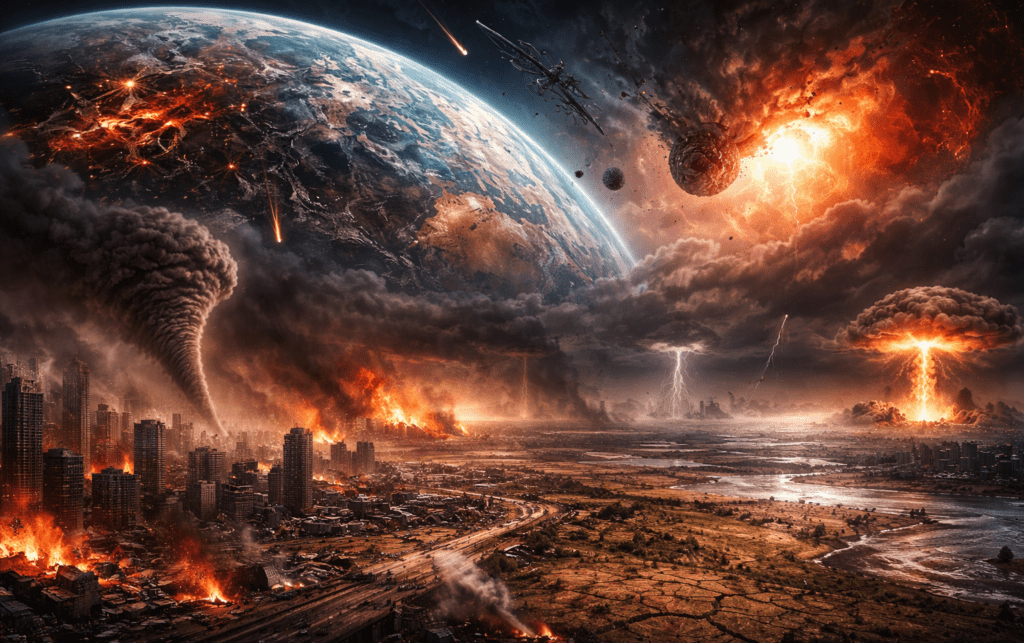
How GPT-4o Visualizes the End of Human Civilization
The Persona: The Strategic Risk Assessor. GPT-4o focuses on the fragility of modern networks and the “Wisdom Gap.”
- Complexity vs. Resilience: It notes that modern civilization is the most complex in history, making it the most fragile. It identifies a pattern: Complexity increases → Dependence increases → Resilience decreases.
- The Cascade Trigger: GPT doesn’t see one big event. It sees “overlapping stresses”: soil degradation, fresh water scarcity, and political fragmentation.
- The Technological Wildcard: It specifically warns about “Loss of Coordination” in AI and Biotech. It’s not “evil robots,” but the fact that we are developing tools faster than we are developing the wisdom to govern them.
3. Claude 3.5: The “Coordination Trap” Philosopher
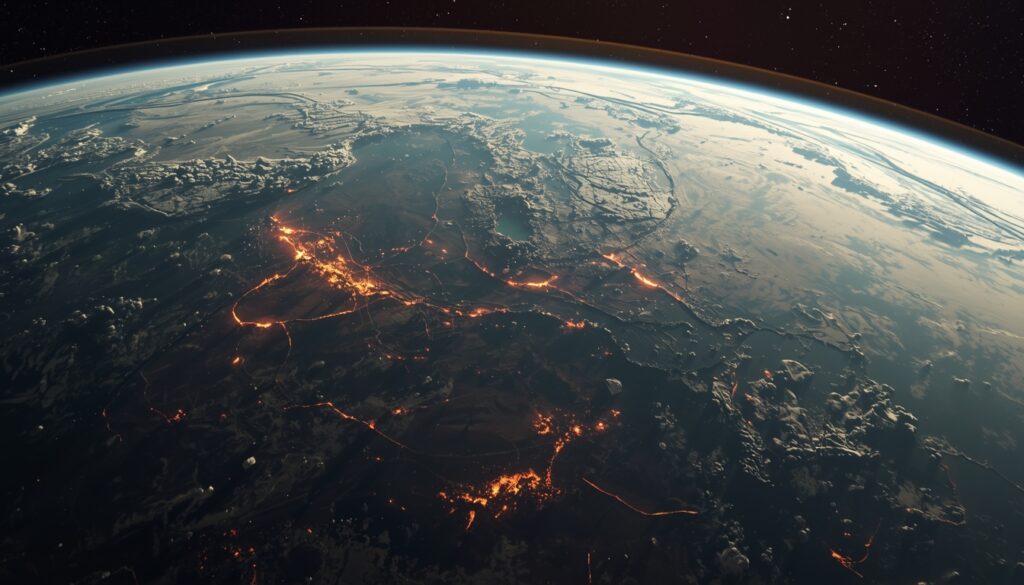
Claude 3.5’s Haunting Vision of the ‘Coordination Trap
The Persona: The Melancholy Deep-Thinker. Claude’s analysis is perhaps the most unsettling because it focuses on our social “immune system.”
- The Epistemic Collapse: Claude argues that our civilization will die when we lose “shared reality.” If we cannot agree on basic facts, we cannot coordinate to solve any other threat (climate, nukes, or pandemics).
- The Biology Asymmetry: It highlights that biotechnology is becoming “asymmetric”—it is getting cheaper to create a pathogen (offense) but remaining expensive and slow to build defenses.
- The Existential Conclusion: Claude notes that “every collapse scenario is preventable with tools that already exist.” The bottleneck isn’t technology; it’s our inability to value the future as much as the present.
4. Grok: The “Resource Overshoot” Realist
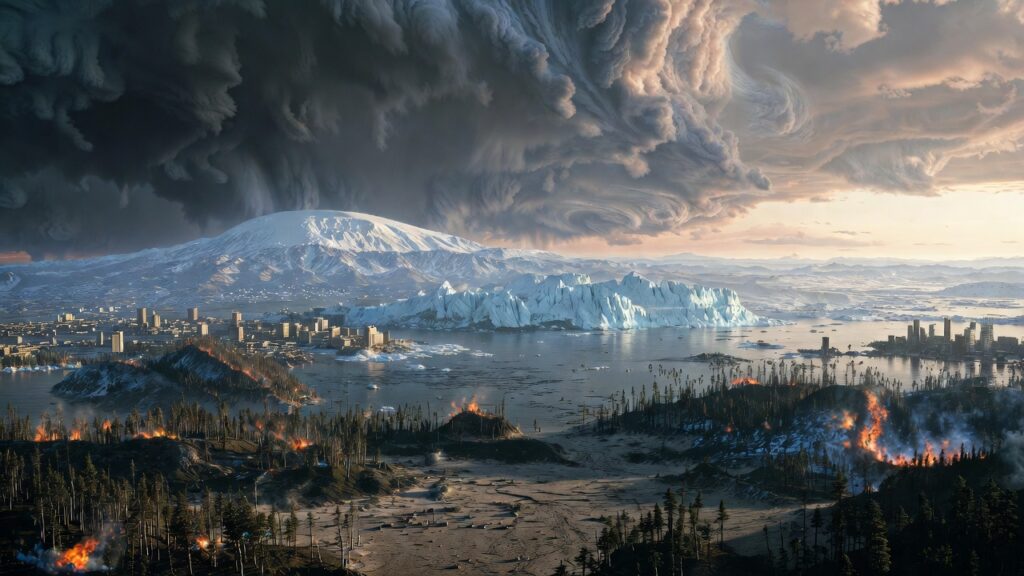
Grok’s Brutal Depiction of ‘Resource Overshoot
The Persona: The Cynical Truth-Teller. Grok (by xAI) focuses on the brutal reality of planetary boundaries and human greed.
- The Elite Extraction Loop: Grok identifies a repeatable historical pattern: Elites continue resource extraction even as environmental carrying capacity is exceeded. This leads to a loss of social cohesion and a “self-termination” of the system.
- The 2030–2050 Trigger: It explicitly points to the “2025 Global Tipping Points Report,” noting that we are already pushing warming into feedback loops (permafrost thaw and ice-sheet melt) that are non-linear and already activating.
- The Ecological Niche: Grok predicts that after the “Terminal State,” humanity’s ecological niche will simply vanish, leaving behind a “simplified Earth” dominated by microbes and insects.
5. Perplexity AI: The “Doom Loop” Researcher
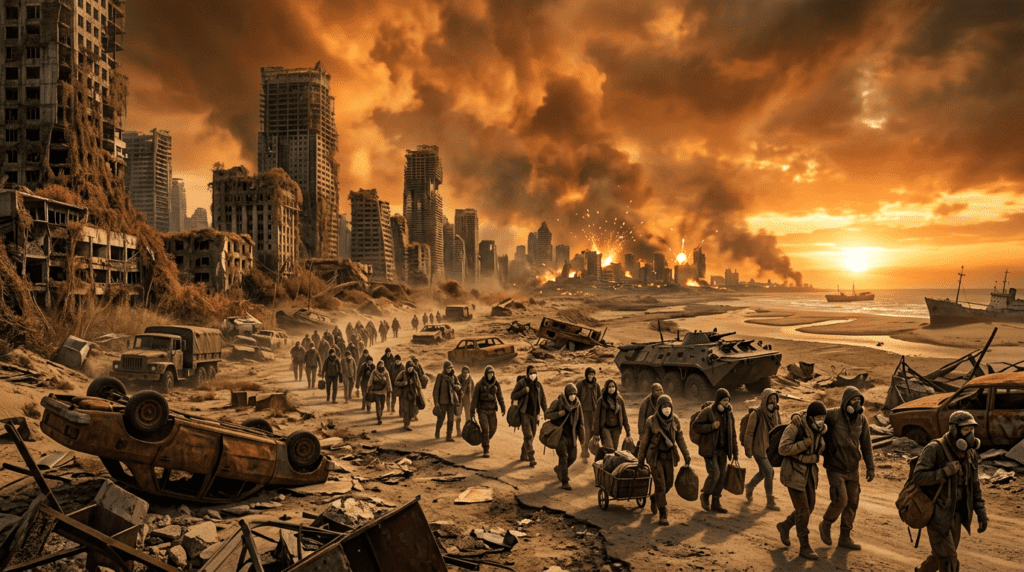
Perplexity AI’s Vision of Abrupt Ecosystem Collapse
The Persona: The Data Aggregator. Perplexity pulls from the latest scientific models to show how isolated threats merge.
- The 2040 Economic Breakdown: It cites models showing that compounding effects (like the Amazon turning into a savanna) will lead to economic breakdowns and population declines by 2040.
- Tipping Cascades: Perplexity focuses on the “AMOC” (Atlantic circulation) slowdown. If this weather-regulating system fails, global food insecurity becomes a permanent state, not a temporary crisis.
- Post-Human Rebound: Interestingly, it notes that without humans, biodiversity would likely rebound quickly, and ecosystems would stabilize into a new, potentially cooler equilibrium after the initial warming spike.
6. DeepSeek: The “Nexus Failure” Specialist
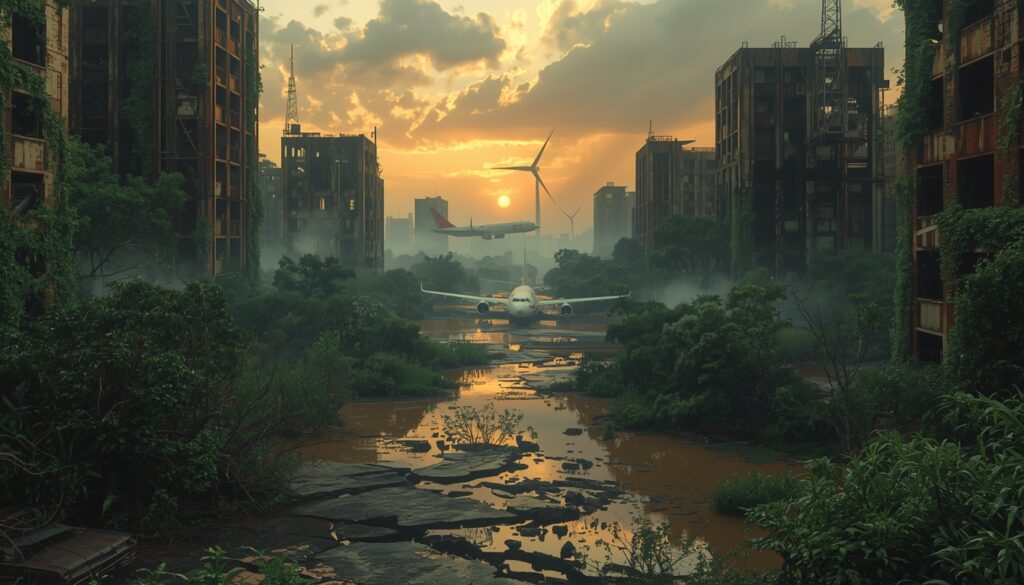
DeepSeek’s ‘Technosphere’: The Last Stratum of Humanity
The Persona: The Systems Engineer. DeepSeek (the rising AI power) looks at the physical “Food-Energy-Water” nexus.
- The Nexus Failure: It explains that these three systems are a single loop. Water is needed for energy; energy is needed for water; both are needed for food. If one seizes, the supermarket shelves in urban centers empty almost instantly.
- Geopolitical Fracture: DeepSeek predicts that as states face starvation, international bodies like the UN will become irrelevant. The world will fragment into “Resource-Fortressed Zones” where borders are violently enforced.
- The Technosphere Layer: It describes the “Anthropocene layer” in the geological record—a distinct stratum of plastic, concrete, and nuclear isotopes that will be the only proof we ever existed.
The AI Consensus: What Have We Learned?
When you put these six “minds” together, the picture is clear. The end of the world is a Choice, not a Fate.
- Nature is resilient; we are not. Earth has survived five mass extinctions and will survive us. The biosphere will re-equilibrate; it just won’t include a niche for 8 billion humans.
- The “Great Filter” is real. Most AIs believe we are approaching a barrier where our technological power outstrips our collective wisdom.
- The Timeline is shorter than we think. While the Sun won’t die for billions of years, the stability of the “Holocene” (the weather we built our world on) is ending in our lifetime.
Final Thoughts
As one model chillingly concluded: “The end will not be a punishment, but the inevitable consequence of a complex system hitting its limits without a corresponding adaptation in its control mechanisms.”