
Games Industry 2025 — Full Year Review

1. Games Industry 2025: Executive summary

This analysis is based exclusively on data from SteamDB/Steam Charts, official financial reports from Sony, Microsoft, and Nintendo, and publisher earnings filings. Success is measured by revenue, active players (concurrent users/MAU), and product lifecycle (retention and long-tail performance). No critic scores or review aggregates are used.The global games market reached $188.8 billion in 2025, up 3.4% YoY according to Newzoo. Growth was modest but positive, driven primarily by console hardware cycles and strong content pipelines. The market stabilized after post-pandemic adjustments, with investors favoring proven IP and multi-platform strategies over risky live-service bets.Platform breakdown:
- Mobile remained dominant at $103 billion (55% share), but growth slowed to ~2-3% in mature markets.
- Console led growth at ~5.5%, reaching ~$46 billion, boosted by the Nintendo Switch 2 launch.
- PC showed steady ~2.5% growth to ~$40 billion, anchored by Steam’s ecosystem.
Key winners:
- Microsoft Gaming reported record $23.45 billion annual revenue (+9% YoY), fueled by Activision Blizzard integration and Game Pass (~$5 billion annually).
- Nintendo capitalized on Switch 2, selling over 10 million units in its partial year (launched mid-2025) and raising forecasts to 19 million by fiscal end.
- Sony G&NS saw strong network services and software sales, with PS5 lifetime units surpassing prior milestones and revenue forecasts upgraded.
Challenges:
- Live-service saturation led to cautious launches and some closures.
- Single-player premium titles demonstrated resilient long-tail revenue on PC and consoles.
- Industry layoffs totaled ~6,000-8,000 in 2025 (down from 2024 peaks), reflecting restructuring amid high interest rates and over-investment corrections.
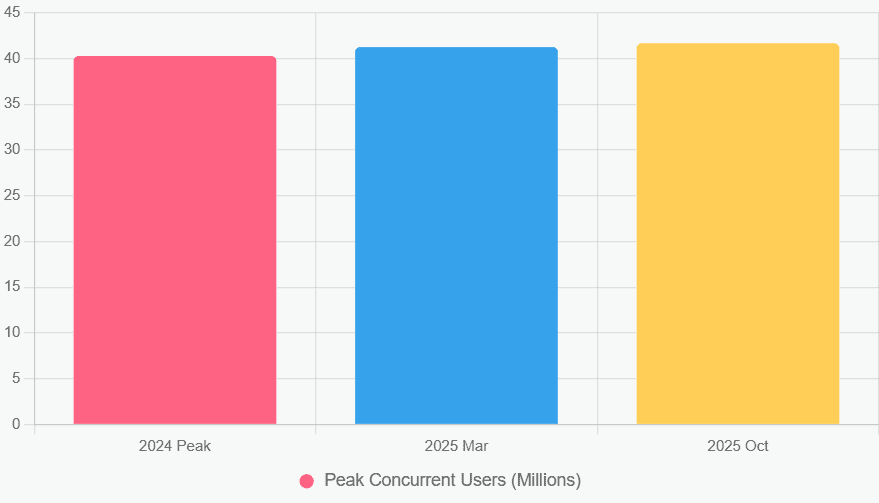
Steam hit a new concurrent users record of 41.66 million (October 2025), with ~132 million MAU and over 19,000 new releases—highlighting PC’s vitality despite discoverability issues.
| Segment | 2025 Revenue (~$B) | YoY Growth |
|---|---|---|
| Mobile | 103 | +2-3% |
| Console | 46 | +5.5% |
| PC | 40 | +2.5% |
| Total | 188.8 | +3.4% |
2025 marked a transitional year: from pandemic highs to sustainable models prioritizing player retention and efficient spending. Winners focused on ecosystems and long-tail earners; losers overextended on unproven services.
Best Games for Couples to Play Together in 2026: Co-op From Easy to Competitive
Top 10 Asian Games That Conquered the World
2. PC Market In 2025 (Steam As Foundation)

2.1 Overall State of Steam
Steam remained the dominant PC platform in 2025, processing over $16.2 billion in gross revenue across all titles through November.
The platform saw 17,889 to over 19,000 game releases for the year, continuing the flood of indie and mid-tier titles, with nearly half receiving fewer than 10 user reviews.
Peak concurrent users hit a record 41.66 million on October 12, surpassing the prior high of 40.27 million from March.
Monthly active users (MAU) hovered around 132-145 million, with in-game concurrent peaks exceeding 13.2 million.Average concurrent users trended upward, supported by major launches.
F2P titles dominated playtime (historically ~51% share), driving engagement through ongoing updates, while paid games fueled upfront revenue.
| Metric | 2025 Value | Notes/Source |
|---|---|---|
| Game Releases | 17,889–19,000+ | Through Nov; SteamDB |
| Peak Concurrent Users | 41.66M (Oct 12) | All-time record |
| MAU Estimate | 132–145M | Year-end projection |
| Platform Revenue | $16.2B (gross, thru Nov) | SteamDB stats |
| F2P Playtime Share | ~51% | Consistent trend |
2.2 Top-Selling PC Games of 2025
Top sellers ranked by gross revenue (Steam charts/SteamDB) featured a mix of new 2025 paid launches and evergreen F2P. No public copies-sold estimates available; rankings proxy strong sales. New releases like ARC Raiders (paid, Oct launch) hit top 3-5 weekly, appealing to core multiplayer audience with extraction shooter gameplay—held positions 13+ weeks.
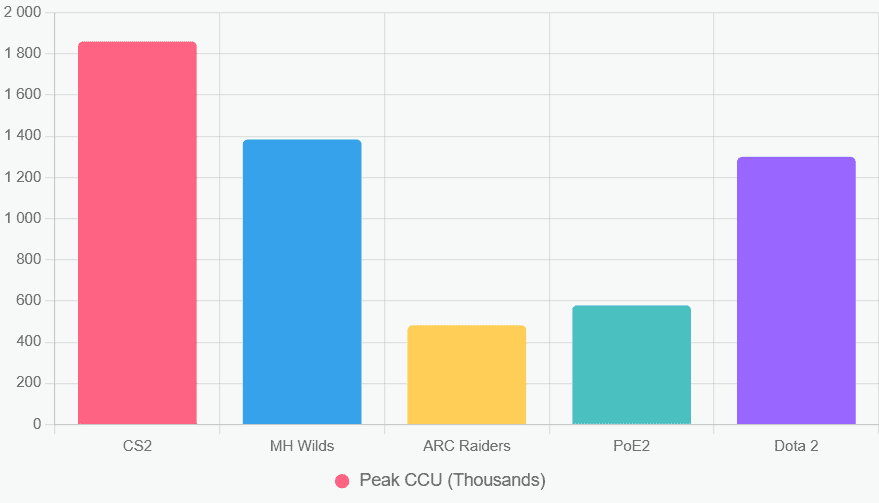
Monster Hunter Wilds (paid, early 2025) debuted #6 all-time sellers (week 1), peak CCU 1.38M; retention strong via seasonal hunts, core fans drove long tail (current ~123K CCU months post-launch).
Kingdom Come: Deliverance II (paid, recent) #8, discount to $29.99 boosted accessibility for RPG core.
Path of Exile 2 (paid $29.99) sustained top 10 via free early access appeal to ARPG veterans.
F2P like CS2 topped charts perpetually, monetizing cosmetics for casual/core mix.
| Top Sellers 2025 (Revenue Rank Proxy) | Type | Peak CCU | Weeks on Chart(approx. chart longevity based on release) | Audience/Longevity Notes |
|---|---|---|---|---|
| ARC Raiders | Paid | 481K | 6 | Core extraction fans; held top 5 |
| Monster Hunter Wilds | Paid | 1.38M | 41 | Core hunters; seasonal retention |
| Kingdom Come: Deliverance II | Paid | 256K | 45 | RPG core; discount tail |
| Path of Exile 2 | Paid | 187K | 53 | ARPG vets; league updates |
| Clair Obscur: Expedition 33 | Paid | 145K | 33 | Turn-based core; steady sales |
2.3 Most Played PC Games of 2025
Most played prioritized high peak CCU (>100K) + stable online 3+ months (current/avg >50K). CS2 led with 1.82M peak (Mar), avg ~500K-1M daily; seasons/mods retained core competitive players year-round.
Monster Hunter Wilds: 1.18M-1.38M peak, stable ~100K+ via expansions. ARC Raiders: 343K peak, current 340K (2+ months)—seasons hooked core co-op shooter fans. Path of Exile 2: 187K peak, steady 150K+ leagues.Models succeeding: Seasonal updates (PoE2, MH Wilds), free DLC/mods for longevity.
Models succeeding: Seasonal updates (PoE2, MH Wilds), free DLC/mods for longevity.
| Top Played 2025 (Peak CCU + Stability) | Peak CCU | Current CCU | Retention Model |
|---|---|---|---|
| Counter-Strike 2 | 1.82M | ~788K | Seasons/mods |
| Monster Hunter Wilds | 1.38M | ~45K | Expansions |
| ARC Raiders | 482K | ~340K | Seasons |
| Path of Exile 2 | 574K | ~155K | Leagues |
| Dota 2 | 1.30M+ | ~507K | Patches |
PC thrived on high-volume releases + retention-focused models, with 2025 launches proving paid premiums viable alongside F2P anchors.
3. Consoles: Sony, Microsoft, Nintendo

3.1 PlayStation in 2025
Sony’s Game & Network Services (G&NS) segment prioritized software and network revenue over hardware. H1 FY2025 (Apr-Sep 2025) sales reached approximately $7.2 billion (up ~4% YoY), driven by network services and game software. Operating income was ~$780 million (down 13% reported due to impairments, but adjusted +23% YoY).
PS5 lifetime shipments: 84.2 million units by Nov 2025 (~3.9M added in Q2). PS5 Pro contributed modestly to US sales. PSN MAU: 119 million (Sep, +3% YoY); playtime +1%. Network services grew from higher PS Plus tiers. First-party live-service >40% of software revenue; multi-platform shift (e.g., Helldivers 2 on Xbox/PC) boosted engagement.
FY2025 forecast: sales ~$29 billion (+3% YoY), operating income ~$3.2 billion.
| G&NS H1 FY2025 (Apr-Sep) | Sales (~$B) | Op Income (~$B) | YoY |
|---|---|---|---|
| Actual | 7.2 | 0.78 | +4% / -13% (adj +23%) |
| Prior Year | ~6.9 | ~0.9 | – |
Software/network dominated, supporting multi-platform strategy.
3.2 Xbox in 2025
Microsoft Gaming FY2025 revenue: $23.5 billion. Content/services +8% YoY (Game Pass, CoD, Minecraft); hardware -6%.
Game Pass: ~37 million subscribers (from 34M prior), ~$5 billion annual revenue (record). Ultimate tier ~68%. Ecosystem growth via Activision; Series X/S estimates ~35M lifetime.Subscription model delivered: record revenue despite hardware dip.
| Microsoft Gaming FY2025 | Value | Notes |
|---|---|---|
| Total Revenue | $23.5B | Full year |
| Game Pass Subs | ~37M | +3M growth |
| Game Pass Revenue | ~$5B | Annual record |
| Content/Services Growth | +8% YoY | Subscription led |
3.3 Nintendo in 2025
Switch 2 (launched June 5, 2025): 3.5M first 4 days, 5.82M Q1 FY2026, >10.36M by Sep. H1 net sales: ~$3.8 billion (+132% YoY), operating profit ~$380 million (+4.4%). Software: 33.07M units (Switch 2: 8.67M; original: 24.4M, -20% YoY but backward compatible).
Original Switch long-tail stable (>100M annual players). Forecast: 15M Switch 2 units FY2026 (raised).
| Nintendo Switch Family H1 FY2026 | Hardware (M units) | Software (M units) |
|---|---|---|
| Switch 2 | >10.36 | 8.67 |
| Original Switch | ~1-2 | 24.4 |
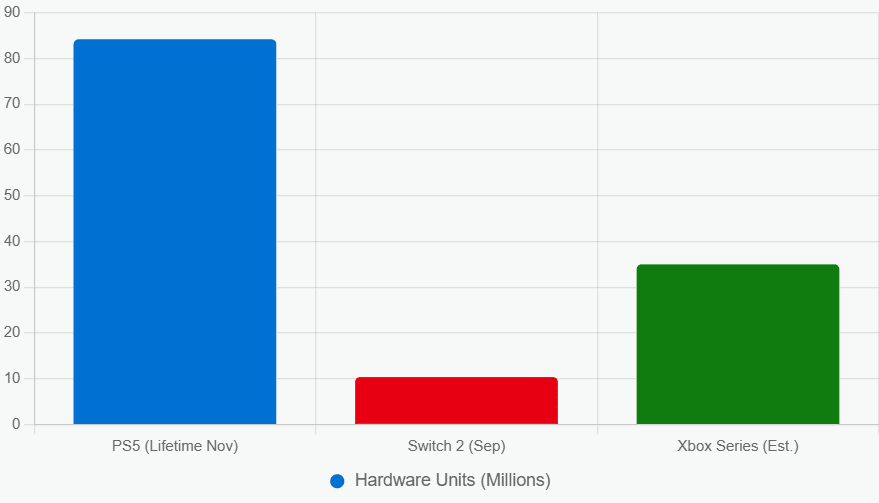
Consoles drove growth through hardware launches (Switch 2) and recurring services (PS/Xbox).
4. Publishers : Who Earned, Who Lost
4.1 Top Publishers by Revenue
Major public publishers showed mixed results in FY2025 (varying fiscal periods, primarily Apr 2024-Mar 2025 or calendar-aligned). Revenue figures from official earnings reports; growth driven by key IP and live services.э
Microsoft Gaming (incl. Activision Blizzard): $23.5 billion full FY2025, up significantly YoY due to Activision integration. Content/services +8-16% quarterly, Game Pass ~$5B annual, CoD/Minecraft core drivers.
Capcom: ¥169.6 billion (~$1.15 billion) net sales, +11.3% YoY; operating income ¥65.8 billion (+15.2%). Record eighth consecutive year of profit growth, led by Monster Hunter Wilds (10+ million units) and catalog (Resident Evil, Street Fighter series long-tail).
Electronic Arts: $7.46-7.5 billion GAAP net revenue, flat to -1.3% YoY. Live services (EA Sports FC, Apex) stable; investments in Battlefield and FC Mobile offset declines.
Take-Two Interactive: Net bookings ~$5.55-5.9 billion guidance range, with GTA Online/NBA 2K recurrent spending dominant (81% in quarters). GTA V long-tail continued strong.
| Publisher | FY2025 Revenue (~$B) | YoY Change | Key IP/Drivers |
|---|---|---|---|
| Microsoft Gaming | 23.5 | Significant + | Activision/CoD, Game Pass |
| EA | 7.46-7.5 | Flat/-1% | EA Sports, Apex Legends |
| Take-Two | ~5.6 | +5% midpoint | GTA, NBA 2K recurrent |
| Capcom | ~1.15 | +11% | Monster Hunter Wilds, catalog |
Top earners relied on evergreen franchises and acquisitions for scale.
4.2 Who Lost in 2025
Several publishers faced declines from over-investment, weak launches, and restructuring.
Ubisoft: Net bookings €1.85 billion ($2 billion), -20.5% YoY; reported €159 million loss. Poor performance from Star Wars Outlaws; XDefiant shutdown announced (June 2025). Ongoing restructuring: headcount down ~1,500 over 12 months, Nordic studios voluntary leaves/proposed cuts; fixed costs -9% YoY.
Embracer Group: Revenue down 22% to $1.5-2.4 billion TTM; ongoing restructuring post-$2B deal collapse. Studio closures (Volition, Free Radical, others), divestments (Saber, Gearbox), headcount reduced significantly (4,500+ impacted historically, continuing into 2025).
Square Enix (HD Games/MMO segment): Digital Entertainment ¥206 billion ($1.4 billion), down from prior ~¥248 billion. Weakness in new HD titles offset by FFXIV Dawntrail; overall profit mixed but segment declines noted.
| Publisher | FY2025 Revenue (~$B) | YoY Change | Key Issues |
|---|---|---|---|
| Ubisoft | ~2.0 | -20% | Weak launches, loss, restructurings |
| Embracer | ~1.5-2.4 | -22% | Divestments, closures post-deal fail |
| Square Enix | ~1.4 (segment) | Down | HD title weakness vs MMO strength |
Losses stemmed from failed live-service bets, high development costs, and market saturation—leading to project cancellations, closures, and cost cuts.
Losses stemmed from failed live-service bets, high development costs, and market saturation—leading to project cancellations, closures, and cost cuts.
5. Live-Service vs Single-Player: 2025’s Key Battleground
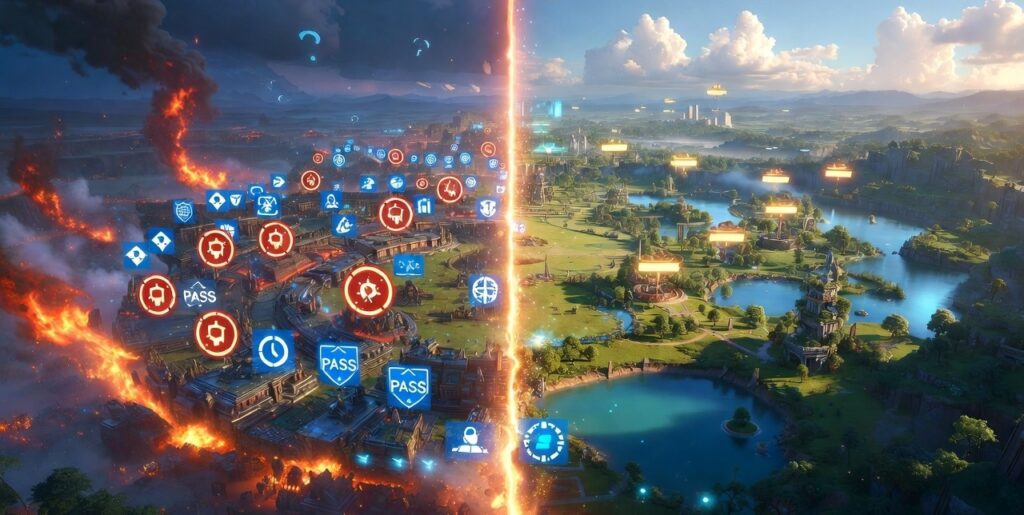
Live-service and single-player models clashed in 2025, with data revealing saturation in services but resurgence in premium long-tail earners. Analysis via SteamDB concurrent players, publisher reports, and market trackers like Newzoo shows live-service dominating playtime (~51% F2P share) but facing retention hurdles, while single-player premiums proved upfront revenue viability.
Live-Service: Holding Strong but Oversaturated
Veteran F2P live-services retained top Steam spots, with peaks over 1M CCU and stable dailies. Counter-Strike 2 led: 1.81M peak, ~1M current/avg; Dota 2: 630k peak, 424k current; PUBG: 861k peak, 362k current; Rust high in tops.These monetized via cosmetics/seasons, sustaining millions MAU.
However, market saturation hit hard: Ubisoft shut down XDefiant (June 2025) after poor retention; Embracer divested/closed live projects amid 22% revenue drop; Sony impaired Bungie/Destiny 2 (~$500M write-down). New launches cautious—publishers like EA/Take-Two leaned on established IP (Apex, GTA Online ~81% recurrent). Steam’s 19k releases flooded discovery, with many F2P dipping below 10k CCU post-hype. Newzoo notes live-service growth slowed, players fatigued by “another shooter/MOBA.”
| Top Live-Service (F2P) 2025 Steam | Peak CCU | Current CCU | Model/Notes |
|---|---|---|---|
| Counter-Strike 2 | 1.81M | ~1.06M | Cosmetics/seasons |
| Dota 2 | 631k | 424k | Patches |
| PUBG | 862k | 363k | Updates |
Closures/divestments signal oversupply—players stick to 5-10 anchors, ignoring rest.
Single-Player Premiums: Revenue Revival via Long Tail
Premium single-player titles countered with strong launches and sustained sales, no heavy MTX reliance. Monster Hunter Wilds (Capcom): 1.38M peak CCU, ~42k current (41w post-launch), drove Capcom’s +11% revenue record via expansions/light DLC. Kingdom Come: Deliverance II: 256k peak, 45w tail; Clair Obscur: Expedition 33: 145k peak, 33w with revivals (1M units first 3 days). Circana YTD tops featured premiums like these in US sales.
Newzoo 2025 report highlights single-player long-tail success on PC/console: DLC/post-launch support (e.g., Sony ports) extends lifecycle without full live ops. Capcom catalog (RE, MH) fueled profits; EA noted premium stability. Steam revenue: Premiums like PoE2 (579k peak, paid EA) blended models but upfront drove ~$58M/month proxies for hybrids.
| Top Premium Single-Player 2025 | Peak CCU | Current CCU | Weeks/Tail Notes |
|---|---|---|---|
| Monster Hunter Wilds | 1.38M | 42k | 41w, DLC |
| Path of Exile 2 (hybrid) | 579k | 174k | 53w leagues |
| Kingdom Come II | 256k | ~15k | 45w discounts |
| Clair Obscur | 145k | ~13k | 33w revivals |
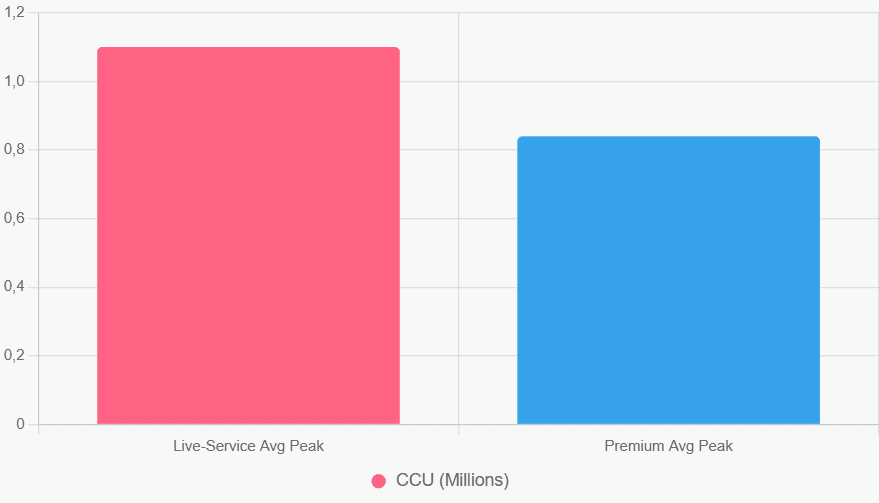
2025 proved live-service vital for volume but risky (closures, saturation); single-player premiums safer for predictable revenue/longevity—publishers pivoting to hybrids/DLC hybrids.
6. Layoffa And Restructuring

The games industry saw approximately 8,000 confirmed layoffs in 2025 through November, down from 2024 peaks but continuing post-pandemic corrections. Trackers like gaminglayoffs.com and Amir Satvat’s data estimate full-year totals at 5,300–8,051, with ~6,247 cited in mid-year analyses—a 45% drop from initial projections.
Major waves hit publishers restructuring after overexpansion:
| Company/Group | Layoffs (2025) | Key Impacts/Notes |
|---|---|---|
| Microsoft Gaming | ~9,000 (gaming portion est. 3,000+) | Closed The Initiative; canceled Perfect Dark, Blackbird MMO; hit Turn 10 (50%), Blizzard (Warcraft Rumble), Raven/Sledgehammer. |
| Ubisoft | ~600+ | Multiple rounds: 9 publishing, 19 Ghost Recon, voluntary at Massive; total ~676 since 2023. |
| Embracer | Ongoing (~100s) | Coatsink (60), divestments; revenue -22% TTM. |
| Square Enix | Mass (undisclosed) | Closed overseas studios; HD segment declines. |
| Crystal Dynamics | 30+ (3 rounds) | Tomb Raider optimization. |
Studio closures included The Outsiders (Funcom/Metal Hellsinger), Atomhawk Canada, Three Fields Entertainment (full redundancy), Glowmade (~12).
Primary causes: overinvestment in live-services (e.g., XDefiant shutdown, Destiny 2 impairments ~$500M), rising interest rates squeezing debt-heavy firms like Embracer, and saturation forcing project cancellations (18+ games axed).Publishers cited “cost optimization” and refocus on core IP amid flat revenue growth.
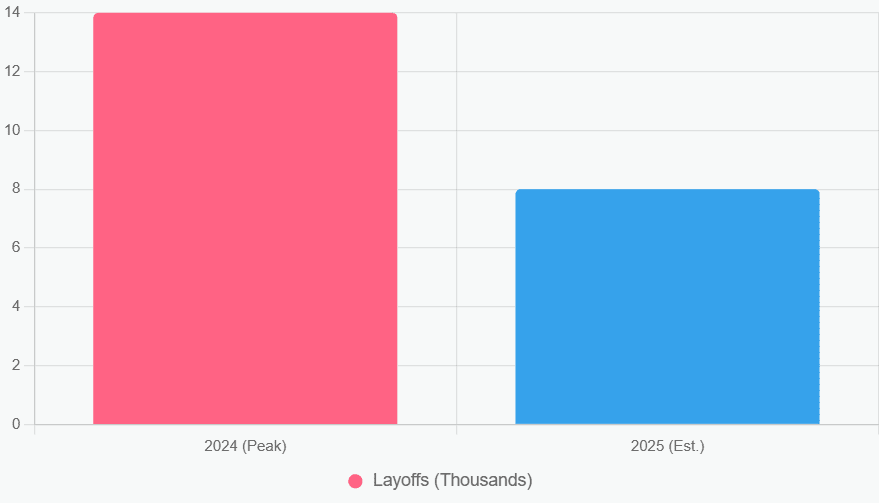
Restructuring slowed mid-year but persisted, targeting efficiency over expansion.
7. What Didn’t Work In 2025

2025 exposed several strategies that failed to deliver returns, based on publisher reports, project outcomes, and market data. Key anti-trends centered on unsustainable costs and misaligned models.
Overloaded Budgets
AAA development costs continued to balloon ($200M+ typical, some exceeding $660M incl. marketing per CMA analysis), but many titles underperformed. Examples include high-profile live-service bets that missed targets, leading to impairments (Sony Bungie/Destiny ~$500M) and cancellations (multiple unannounced projects). Result: flat or declining revenue for segments relying on blockbuster scale without proportional sales growth.
Live-Service Without Clear Differentiation
Saturation hit hard—new entrants struggled against entrenched F2P anchors (CS2, Dota 2 peaks >1M CCU). Failures like Ubisoft’s XDefiant shutdown (June 2025) and Embracer divestments highlighted “another service” fatigue. Publishers noted player rejection of undifferentiated shooters/MOBAs; recurrent revenue concentrated in top 5-10 titles (~80% genre share in cases).
Blind Trend-Following
Chasing hero shooters/extraction modes post-2024 hype led to cancellations (e.g., Sony/PlayStation unannounced live-service). Warner Bros. over-reliance on services (post-Suicide Squad echoes) contributed to restructuring. Outcome: 18+ projects axed industry-wide, per trackers.
| Anti-Trend | Example Impact | Consequence |
|---|---|---|
| Bloated AAA Budgets | $200M+ dev + marketing | Impairments, flat YoY revenue |
| Undifferentiated Live-Service | XDefiant shutdown, saturation | Player churn, closures |
| Trend-Chasing Launches | Hero shooter wave cancellations | Project ax + studio cuts |
These missteps accelerated restructuring: cost cuts -9% at affected publishers, focus shifted to proven IP/long-tail.
8. What 2025 Revealed About The IIndustry’s Future

Data from 2025 points to cautious investment priorities and surviving models.
Publishers doubled down on evergreen IP and ecosystems: Microsoft ($23.5B revenue) via Activision/CoD integration; Capcom record profits (+11%) from MH Wilds/catalog; Nintendo Switch 2 (10M+ units) + backward compatible long-tail.
Multi-platform and hybrid models gained traction: Sony ports/network growth; premiums with light DLC (MH Wilds expansions) extended lifecycle without full live ops risk.
Retention-focused development prevailed: Seasonal/league updates retained players in viable services (PoE2 579k peak, stable 174k); single-player long-tail (KCD2/Clair Obscur sustained sales weeks post-launch).
Market signals for 2026: modest growth (~3-5%), emphasis on efficiency—fewer risky services, more proven franchises/multi-device support. Steam’s 41M+ CCU record underscores PC vitality; console cycles (Switch 2) drive hardware-led spikes.
| Surviving Model | 2025 Evidence | Implication for 2026 |
|---|---|---|
| Evergreen IP | Capcom +11%, GTA Online recurrent | Core franchise focus |
| Hybrid Retention | PoE2 leagues, MH DLC | Light updates over full live |
| Ecosystem/Multi-Platform | Microsoft Game Pass $5B, Sony ports | Recurring revenue priority |
2025 data indicates selective investment: models with proven money + players + lifecycle win; high-risk bloat loses.
Final Thoughts
2025 marked a transitional year for the games industry: shifting from the chaotic post-pandemic boom to a disciplined era where only models delivering proven returns on money, players, and lifecycle survived.

Key takeaways from the year’s data:
- Selective growth prevailed — Global market +3–5%, led by consoles (+5.5%) and steady PC (+2.5%). Winners built ecosystems (Microsoft $23.5B revenue, Nintendo Switch 2 >10M units).
- Live-service saturation became evident — Veterans (CS2, Dota 2) held millions in CCU, but new entries closed quickly (XDefiant, multiple cancellations). Players rejected “yet another service.”
- Single-player and hybrids reclaimed revenue — Premium launches (Monster Hunter Wilds 1.38M peak, KCD2/Clair Obscur long-tail) plus light DLC/seasons proved reliable without full live-ops risk.
- Efficiency trumped scale — ~8,000 layoffs, closures, and impairments ($500M+ in isolated cases). Top earners (Capcom +11%, Microsoft record) focused on proven IP; losers overextended on unproven bets.
- Multi-platform and retention became the new standard — Sony ports/network growth, Microsoft Game Pass ~$5B, Capcom catalog. Revenue flows to titles players stick with for years.
Players learned: they’re willing to pay upfront for quality experiences without FOMO or endless grind, but ignore undifferentiated services.
Studios and publishers learned: the era of “throw $300M and see” is over. The future belongs to disciplined development of evergreen franchises, hybrid models, and genuine player retention—not hype.
2025 closed the door on the reckless 2020s and opened the path to a more mature, sustainable industry.