
“The Digital Mirage”: Why Screen Time Features Aren’t Fixing Your Scrolling Addiction in 2026

The Paradox of Digital Wellness
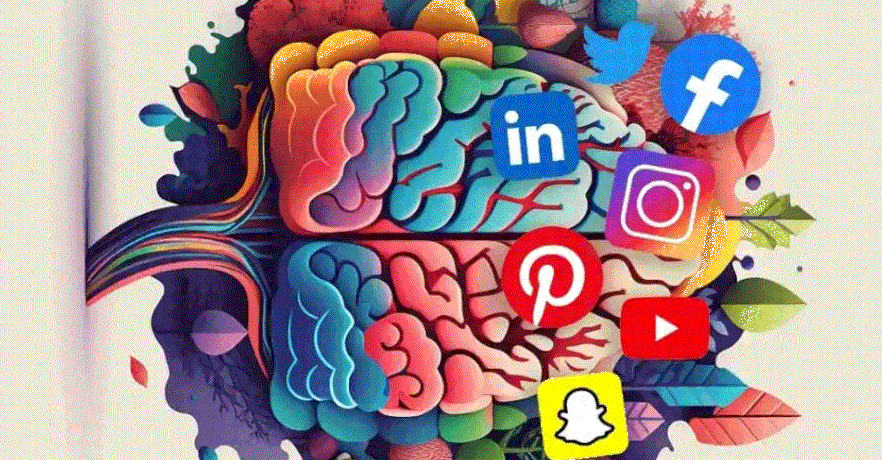
By April 2026, every smartphone user has a “Screen Time” report delivered to their lock screen once a week. Yet, average global usage has climbed to 7.5 hours per day. The feature, designed by the same companies that profit from your attention, is fundamentally flawed. It treats digital addiction as a lack of information rather than a lack of agency. Knowing you spent 3 hours on TikTok doesn’t change your brain’s dopamine reward system; it just adds a layer of “digital guilt” to the experience.
1. The “Ignore Limit” Trap: Design for Defeat
The most used button in the Screen Time interface isn’t “OK”—it’s “Ignore Limit for Today.” In 2026, UX (User Experience) designers have perfected “Soft Friction.” The limit isn’t a wall; it’s a polite suggestion. Because Apple, Google, and Meta operate on the attention economy, they cannot afford to build a feature that actually locks you out. The Screen Time feature is a form of “Ethical Theater”—it makes the company look responsible while ensuring you stay on the platform.
Best Supplements for Focus in 2026: What Science Actually Supports
The Digital Hallucination: How Social Media Algorithms Decide What You Believe Is Normal in 2026
2. Cognitive Dissonance and the “Guilt Cycle”
When the notification pops up telling you that you’ve reached your limit, it triggers a brief moment of stress.
- The Reaction: To alleviate that stress, the brain seeks comfort.
- The Comfort: Ironically, we find that comfort back in the very apps we are trying to avoid. This creates a “Guilt-Scroll Loop.” By the time 2026 rolled around, researchers found that Screen Time alerts often increase usage in the hour following the alert, as users subconsciously rebel against the “parental” tone of their device.
3. The “Productivity” Deception
Screen Time categories are notoriously bad at distinguishing between “Value” and “Noise.” In 2026, your phone might group an AI-driven educational tool and a mindless doom-scrolling app into the same “Social” or “Productivity” bucket.
The Reality: We justify 6 hours of screen time because “2 hours were for work,” ignoring the fact that our attention span is being fragmented regardless of the app’s category.
Why Your Brain Ignores the Data
In 2026, we’ve learned that habits are formed by cues, not by statistics. A bar chart showing your weekly usage doesn’t address the cue (boredom, anxiety, or the buzz of a notification).
- The AI Overload: With AI-generated content making feeds more addictive than ever in 2026, a simple timer is like bringing a knife to a nuclear war.
- The Social Cost: “Opting out” of the screen often means opting out of 2026 social life, making the “limit” feel like a punishment rather than a health choice.
Final Thoughts: Beyond the Timer
If you want to change your habits in 2026, stop looking at the charts. The Screen Time feature is a mirror, but a mirror doesn’t fix a broken arm. To achieve a real Deep Reset, you must change your environment, not your settings. Turn off the notifications, leave the phone in another room, and acknowledge that Big Tech will never build a tool that truly helps you use their product less.