
Online Income in 2025 — Year-End Report

Why 2025 Was a Defining Year for Online Income
2025 marked a year of maturation and stratification in online earning. Digital income streams scaled further, freelance platforms hit record profitability, and AI solidified its role as an augmenter of high-skill work rather than a universal disruptor. This updated report incorporates the latest verified data from Q3/Q4 2025 reports, refining earlier figures and adding fresh insights on market size, AI premiums, and generational shifts.
1. Freelancing Solidified as a Core Pillar of Global Work

Freelance Workforce Expansion
Upwork’s Future Workforce Index (April 2025) remains the benchmark:
- 28% of U.S. skilled knowledge workers now freelance or work independently.
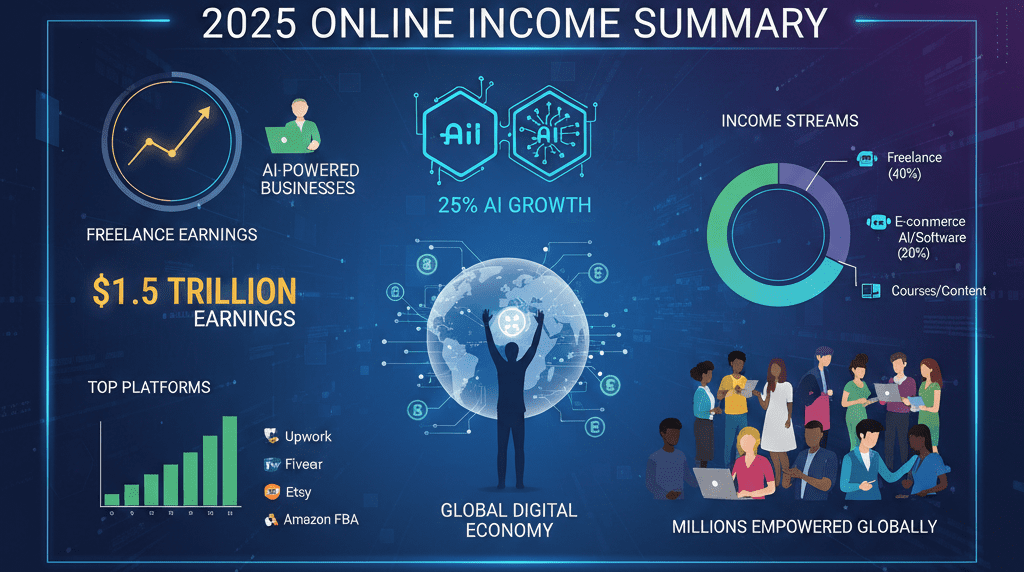
- This segment generated approximately $1.5 trillion in earnings in 2024 (latest comprehensive figure; 2025 estimates suggest continued growth).
- Full-time independent professionals maintain a median income edge ($85,000) over traditional employees ($80,000).
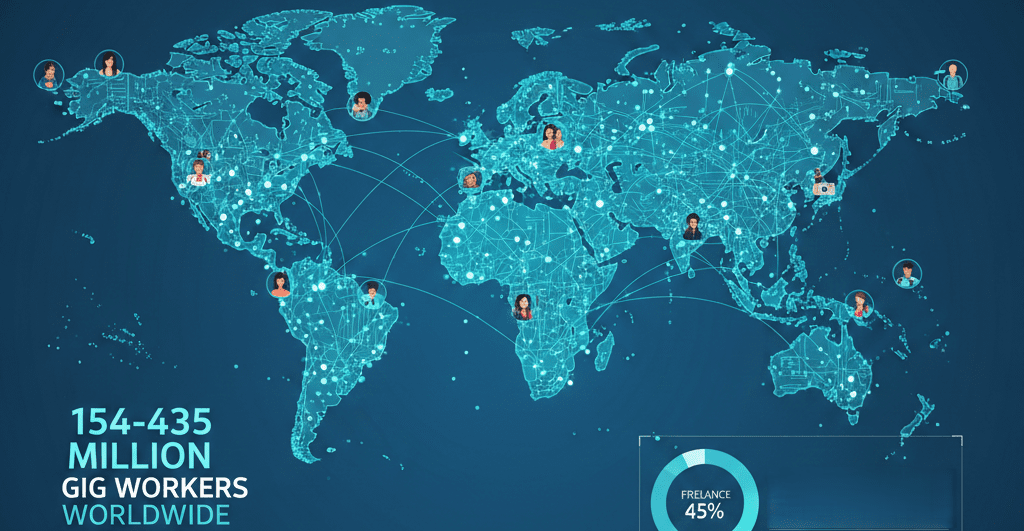
Globally, the U.S. has ~76 million freelancers (36% of the workforce), while worldwide gig participation ranges from 154–435 million workers.
Platform signals confirm strength: Upwork achieved record quarterly revenue of $201.7 million in Q3 2025 with GAAP net income of $29.3 million, building on Q1’s record $37.7 million profit.
Why Some People Make $100/Month Online and Others Make $10,000 — The Real Differences
What Awaits Dropshipping in 2026 — Trends, Truths, and the Future of E-Commerce
2. AI’s Real Impact: Augmentation, Not Replacement

AI Boosts Premium Earnings in High-Skill Roles
2025 data shows AI rebalancing rather than eradicating jobs:
- Upwork reported AI-related Gross Services Volume (GSV) grew 25% YoY in Q1 2025, with some categories reaching 52% YoY.
- Freelancers with AI skills command significant premiums: 22–45% higher hourly rates depending on specialty (Upwork, industry reports).
- High-value categories (e.g., AI modeling, machine learning, generative AI) saw the strongest demand, while low-complexity repetitive tasks faced substitution.
Translation: Professionals who integrate AI tools earned more, not less — confirming “human + AI” as the winning formula.
3. Broader Gig Economy Scale
Global Footprint
Estimates place 154–435 million people worldwide in regular online gig/freelance work.
In the U.S. alone, gig workers represent 36% of the workforce (~76 million people).
High-earners (>$100k annually) grew to an estimated 5–6 million in the U.S., highlighting increasing stratification.
4. Creator Economy: Massive Scale, Persistent Inequality
Market Size & Earnings Reality
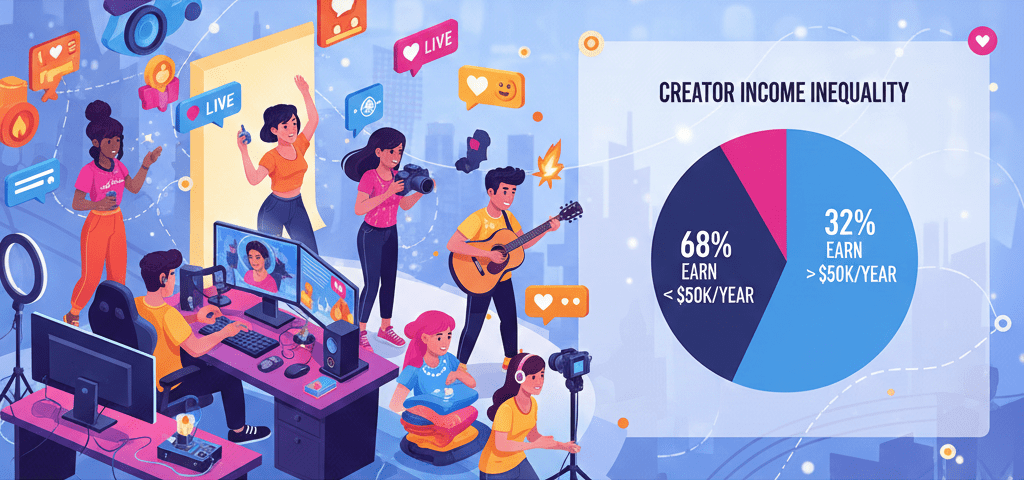
The creator economy reached approximately $250 billion globally in 2025 (estimates range $205–252 billion, with ad spend alone hitting $37 billion — up 26% YoY).
Yet income distribution remains highly skewed:
- Over 68% of creators earned less than $50,000 annually.
- Only ~5–6% earned more than $200,000.
- Side-hustle creators averaged ~$1,200/month supplemental income.
New trends: Rising adoption of digital products (courses, templates), subscription models, and AI tools (used by 80%+ of creators for productivity).
5. Generational Shift: Income Stacking Becomes Default

Gen Z Redefines Security
Fiverr’s Next Gen of Work report (October 2025) reveals stark attitudes:
- 67% of Gen Z view multiple online income streams as essential for financial security.
- 54% believe traditional full-time employment will become obsolete.
- Only 15% of Gen Z freelancers see AI as a major competitive threat (vs. higher concern among older generations).
This cements “income stacking” as a foundational strategy for younger workers entering the market.
6. Platform & Industry Signals
Continued Platform Growth Amid Higher-Value Focus
Upwork and Fiverr both posted strong 2025 results: record revenues, improving profitability, and shifting demand toward premium skills (project management, QA, AI integration).
High-value work among large enterprises grew 31% (Upwork data).
Active buyer counts stabilized or slightly declined as companies prioritized quality over volume.
Key Verified Takeaways From 2025
| Trend | What Actually Happened (Data) | Source |
|---|---|---|
| Freelance scale | 28% U.S. knowledge workers; ~76M U.S. freelancers (36% workforce); $1.5T earnings (2024) | Upwork, industry reports |
| Global gig workforce | 154–435 million participants worldwide | Multiple estimates |
| AI impact | AI work GSV +25–52% YoY; AI-skilled freelancers earn 22–45% premium | Upwork, Axios |
| Creator economy size | ~$250B market; $37B ad spend | Grand View, IAB |
| Creator income | >68% < $50k/year; ~5–6% > $200k | NeoReach, surveys |
| Gen Z attitudes | 67% see income stacking essential; 54% predict end of traditional jobs | Fiverr 2025 |
| Platform performance | Upwork Q3 revenue $201.7M, net income $29.3M | Upwork IR |
Final Thoughts
The Real Online Income Story of 2025
2025 wasn’t about universal riches — it was about scale, stratification, and adaptation.
- Freelance and gig work achieved undeniable economic weight (trillions in earnings, hundreds of millions of participants).
- AI rewarded skilled integrators with premium pay while automating routine tasks.
- The creator economy ballooned to quarter-trillion-dollar size but retained extreme income inequality.
- Gen Z fully embraced diversified digital income as the new normal.
The defining reality: Online income is now mainstream, stable, and increasingly skill-dependent. Those who upskilled — especially with AI — thrived; others competed in saturated lower tiers. Heading into 2026, the gap between high-skill and entry-level online work is only widening.