
When Hype Costs a Fortune — Tech, Games, and Crypto Gone Wrong

The Anatomy of the Hype Cycle
Every few years, a new “breakthrough” emerges — be it in tech, gaming, or crypto — promising to change everything. We get swept up in the momentum: innovation → hype → investment boom → reality check → collapse. This cycle is often visually represented by the Gartner Hype Cycle, where the Peak of Inflated Expectations inevitably leads to the Trough of Disillusionment.
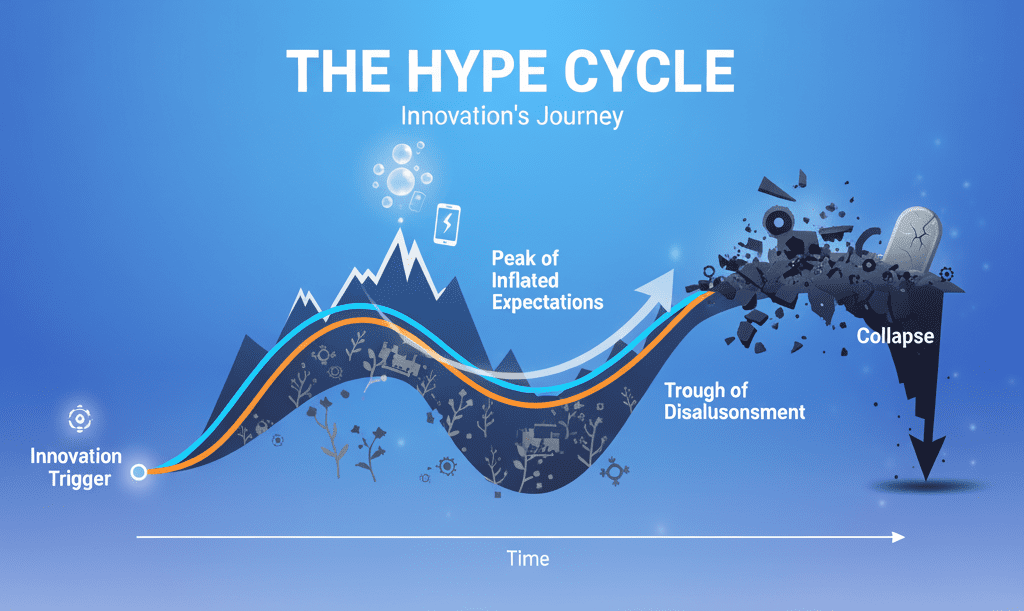
In many cases, the outcome is the same: inflated expectations, massive losses, and disillusioned users and investors.
Thesis: Whether it’s a medical startup, a next-gen video game, or a revolutionary coin, the pattern repeats — promises of a revolution end in financial loss and broken trust.
Key question: Why do we keep believing “this time it’s different”? Because FOMO (Fear of Missing Out) and the promise of easy, exponential returns often overpower critical thinking.
And right now, as AI, Web3 and “the metaverse” dominate headlines again, the same cycle is quietly beginning anew.
1. 📉 Tech Gone Wrong — When Vision Meets Reality
The tech world often rides the hype wave hardest. Lofty promises and large funding rounds sometimes mask little to no working product. The failure here often stems from a failure of due diligence — both by investors and by media.
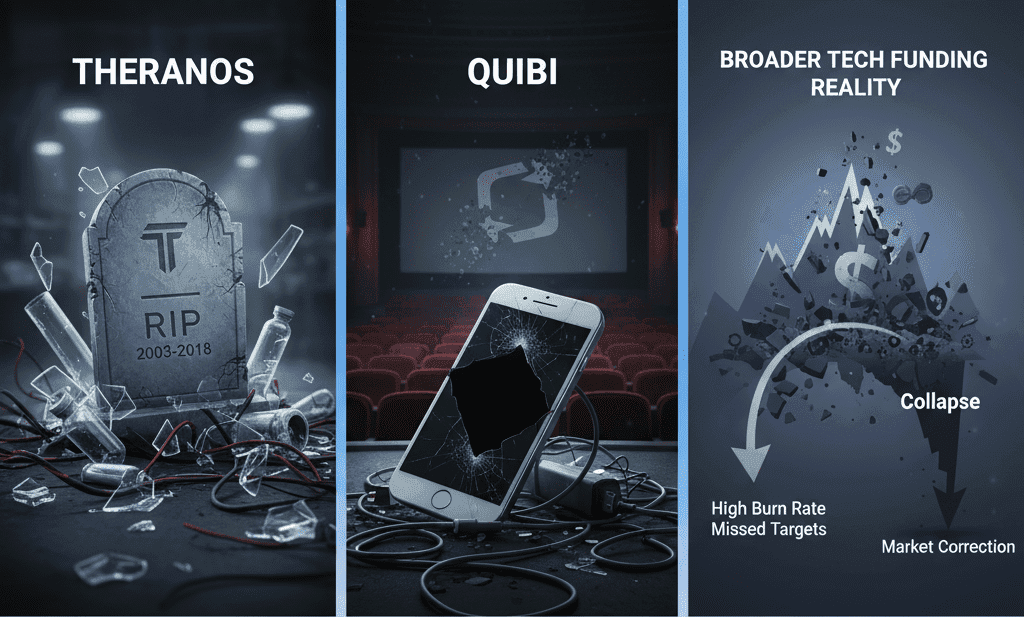
Theranos
Founded by Elizabeth Holmes, Theranos raised over US$700 million and reached a valuation of about US$9 billion. The core claim: a device able to run hundreds of blood tests from a finger-prick sample. The reality check: the technology was fundamentally flawed, leading to major inaccuracies, regulatory failures, and lawsuits. Holmes was convicted for fraud. This case clearly shows how hype + charismatic leadership + a monumental failure of scrutiny by investors and board members equals disaster.
Quibi
This mobile-first streaming platform launched with a staggering US$1.75 billion in funding. Despite the massive capital, the service shuttered just six months after launch. The contrast: Quibi’s failure stemmed from low adoption, market misunderstanding and a high burn-rate. It proves that money alone cannot buy success if the fundamentals and the product-market fit are weak. Meanwhile, platforms like TikTok demonstrated organic growth with far less initial capital — simply because they understood their audience.
Broader Tech Funding Reality
While hype was at full throttle, the money started to pull back. For example: global venture-capital funding in 2023 dropped to approximately US$285 billion — a ~38 % decline year-over-year. By the end of 2023, monthly funding rounds and deal volumes hit lows not seen since 2017.
This data hints at the fact that hype-heavy businesses are now facing much harsher scrutiny — yet the cycle keeps repeating.
The Digital Hallucination: How Social Media Algorithms Decide What You Believe Is Normal in 2026
“The Wealthy Mindset”: 7 Financial Habits of People Who Never Feel Broke (Even in 2026)
2. 🎮 Gaming Hype — When Marketing Destroys the Game
In the gaming industry, trailers and promises build a fragile scaffold of expectations. When it collapses, the reputation damage can be immense, costing years of goodwill.
Cyberpunk 2077
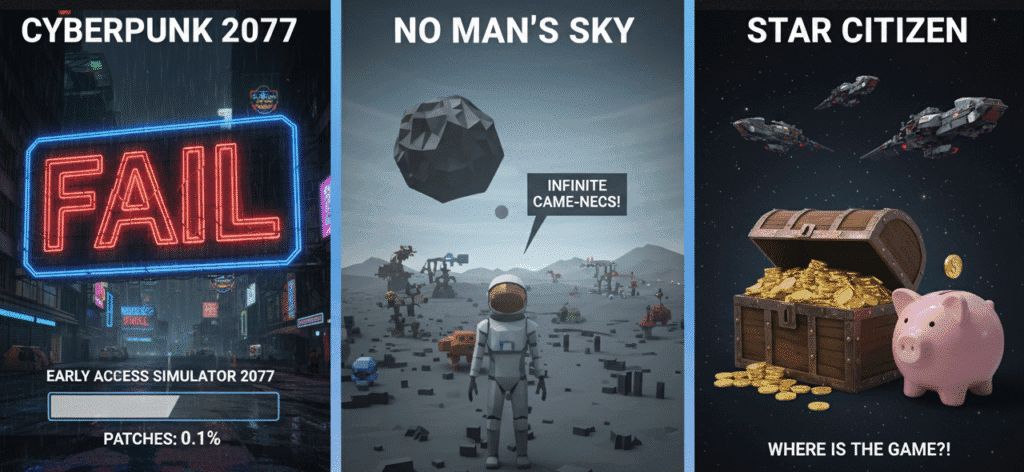
Heavily promoted with stellar trailers, the launch hype for Cyberpunk 2077 was astronomical. Yet, the release was plagued by bugs, performance issues (especially on consoles), refund campaigns, and even lawsuits. The true cost: the developer, CD Projekt Red, had built an almost unimpeachable reputation with The Witcher 3 — this failure is a textbook case of hype overtaking development reality, proving that a single over-hyped launch can destroy multi-year brand trust overnight.
No Man’s Sky & Anthem
Both promised vast, living worlds with features that were largely missing at launch. While No Man’s Sky is a rare example of eventual redemption through years of free updates, both it and Anthem highlight how initial hype leads to severe unmet expectations and forces developers into years of damage control.
Star Citizen — The Game That Never Launches
Originally crowdfunded in 2012, Star Citizen has raised over US$800 million from backers after more than a decade — yet the full game still lacks a release date. This is the perfect case study of hype’s longevity: a dream so big that its community keeps funding it, even without a finished game. It shows a different angle: not always outright fraud, but persistent over-promise, perpetual development and the consequences of “hype as business model”.
NFT / Play-to-Earn Games
This is where gaming hype meets speculative finance. Early P2E games like Axie Infinity promised “play to earn” — but when the game economies collapsed or turned into an unsatisfying “work to earn” grind, users were left holding devalued, worthless tokens. This merges gaming hype with speculative finance — a dangerous mix that illustrates the intersection between two of the biggest hype-machines.
3. 🪙 Crypto & Finance — When Bubbles Burst
The crypto sector provides the most dramatic and financially devastating examples of hype gone wrong, often catalyzed by a lack of accountability and regulation.
FTX
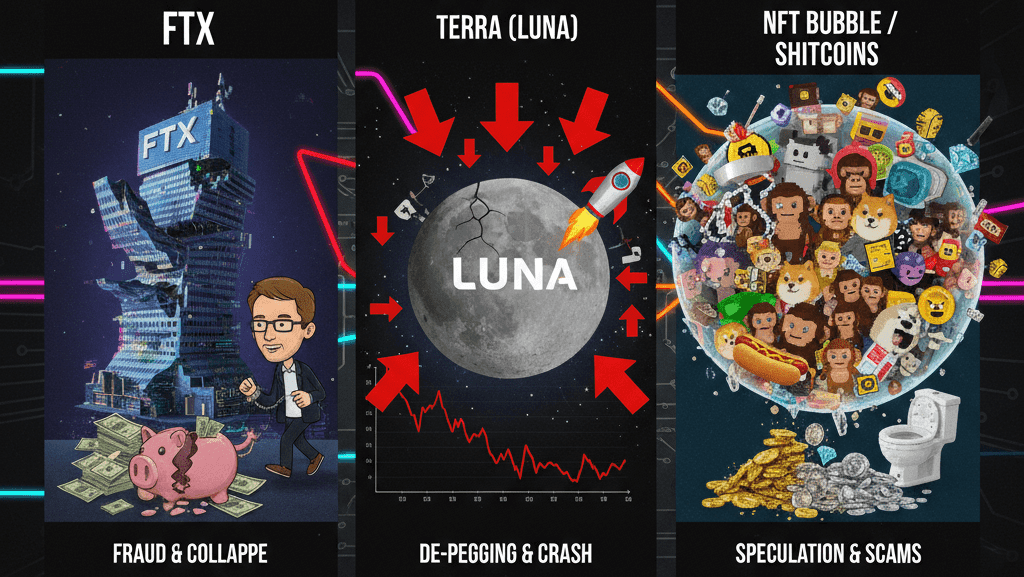
FTX, valued at over US$32 billion at its peak, collapsed in November 2022 revealing misuse of customer funds, shocking lack of internal controls, and outright fraud. Court filings indicated the exchange owed billions to creditors. This was not just a crypto crash; it was a modern financial scandal.
Terra (LUNA) & UST
The spectacular collapse of the “algorithmic stablecoin” LUNA and its associated token UST in May 2022 erased tens of billions in value and shook trust across the DeFi ecosystem. It exemplifies how speculative promise, amplified by community hype, can backfire spectacularly and trigger a ripple-effect across an entire sector.
NFT Bubble / “Shitcoins”
The explosion of sky-high valuations for digital art and meme coins in 2021–2022 was driven by speculation, social-media influence and FOMO. Many of these assets later plunged to near-zero value. The issue here is the heavy reliance on marketing rather than intrinsic value. Influencers and celebrities often promoted these projects for profit, further fueling the dangerous cocktail of hype.
4. 🧠 Why the Cycle Never Ends
Across tech, games and crypto the formula keeps repeating:
- A compelling story + charismatic founder.
- Large funding + aggressive, unrealistic timelines.
- Over-promotion, under-delivery (often with a fraudulent or weak foundation).
- Collapse blamed on “bad timing” or “market conditions”.
- The next day, a new hype wave begins.
Why do we keep falling for it? Because hype is the engine of extraction and a powerful narrative. Investors and users consistently prioritise a mesmerizing story (“the next Amazon/Google/Bitcoin”) over boring, but essential, technical and financial data. For the “visionaries” and early participants, the rewards of being right once far outweigh the cost of being wrong many times.
And in the current environment, the backdrop is especially fertile: global venture-capital funding has shrunk significantly (e.g., global startup investment in 2023 dropped ~38% from 2022). Yet, the stories remain as loud as ever — because the promise of a revolution still sells.
5. 🛡️ The Lessons We Never Learn
To avoid being caught in the next crash, critical thinking must replace aspirational excitement.
Checklist of Red Flags:
- No independent proof of success or a working product.
- Overly charismatic leadership paired with little operational transparency.
- Huge valuation/funding before achieving product-market fit.
- “Guaranteed returns”, “Revolutionary tech”, or high-pressure sales tactics.
- Heavy reliance on marketing and potential rather than fundamentals and current reality.
The Fundamental Question: If the hype and the promise of quick profit were removed, would this product, game or asset still make sense?
Final Thoughts – The True Cost of Hype — More Than Just Money
Hype isn’t inherently bad — it drives ambition and innovation. But when hype replaces substance, the cost is far more than financial. Money, time, and, most importantly, trust in true innovation are all sacrificed. Whether it’s a failed gadget, a buggy game, or a busted exchange — the same story repeats. Recognising the pattern is the first step to avoiding the damage.