
The AI Future We Didn’t Ask For

How 20th-Century Dreams Turned Into Content Noise
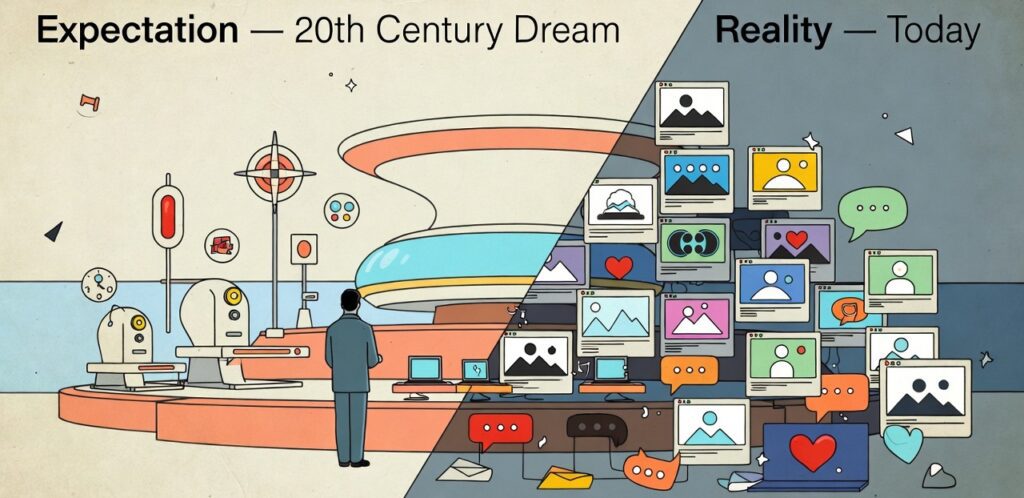
In the 20th century, artificial intelligence was imagined as a breakthrough of the human mind. Writers, scientists, and filmmakers believed that machines would eventually learn to think, reason, and question reality alongside us. AI was supposed to be rare, powerful, and meaningful — something closer to a new form of intelligence than a массовый инструмент.
The fear was never about boredom or mediocrity. The fear was that AI would become too smart.
That future never arrived.
Instead, AI entered the world quietly and pragmatically, not as a thinking entity but as a production system. It didn’t challenge humanity philosophically. It optimized content pipelines, flooded platforms, and reshaped the internet into something unrecognizable.
The machines didn’t take over cities. They took over attention.
From Artificial Intelligence to Artificial Content
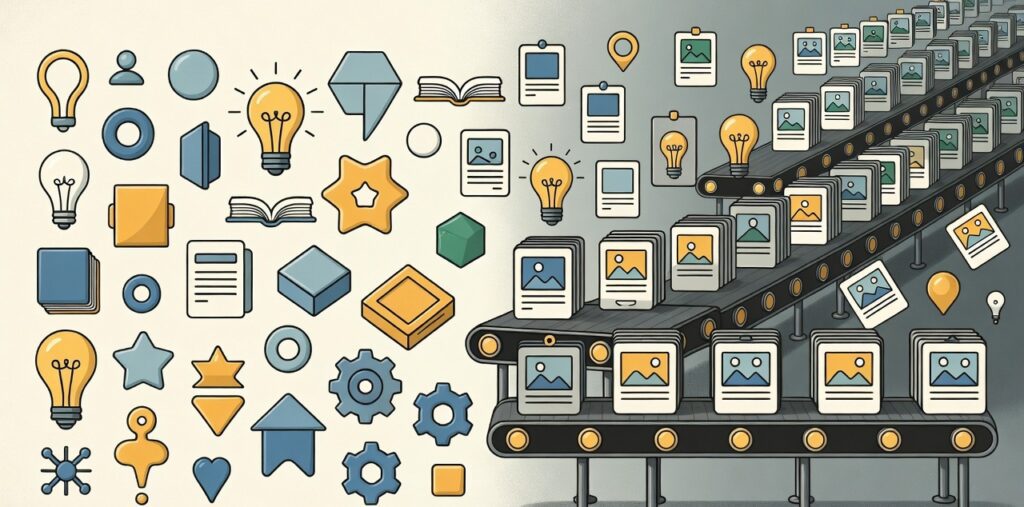
Modern AI does not understand meaning, culture, or intent. What it understands extremely well is patterns. Given enough data, it can replicate the shape of human expression with impressive accuracy. That ability made AI the perfect tool for an internet built around engagement metrics.
Today, AI is not primarily used to solve complex scientific problems or to remove humans from dangerous physical labor. Instead, companies deploy it to generate articles, thumbnails, voiceovers, short videos, and posts at industrial scale.
Entire YouTube channels exist without creators. Articles are rewritten endlessly with slightly different keywords. Short-form platforms are filled with synthetic voices reading synthetic scripts.
As a result, this shift does not represent intelligence replacing humans. It represents output replacing meaning.
Canva AI vs Adobe Express vs Figma: Best Design Tool for Non-Designers in 2026?
Why Every Gadget Looks the Same in 2025 — and Why That’s a Problem
The Dead Internet Theory Is No Longer Abstract
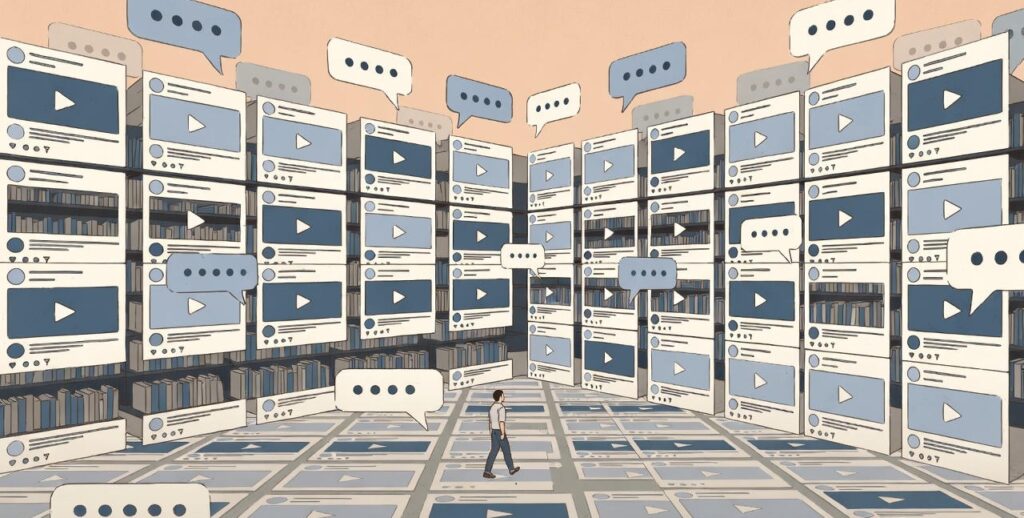
The so-called Dead Internet Theory suggests that a large portion of online content is no longer made for people, but for algorithms. AI creates content to satisfy ranking systems, while algorithms evaluate that content to decide what should be promoted, copied, or monetized next.
Humans still scroll through this ecosystem. However, they are no longer central to it. The system increasingly works for itself.
In the 20th century, people feared robots would replace workers. In the 21st century, AI began replacing the audience.
Dreams vs Reality
The gap between expectations and reality is impossible to ignore.
Many people expected AI to compose music while humans enjoyed more free time. Instead, the opposite happened. Today, many work longer hours simply to afford subscriptions to tools that generate endless low-effort content.
People once imagined robots cleaning streets and washing dishes. Meanwhile, physical labor remains human, while AI competes with artists, writers, and designers — the very roles that once defined creativity.
Technology promised liberation. What it delivered was saturation.
The Collapse of the Attention Economy
Before AI, even bad content required time and effort. As a result, creation had a natural limit that filtered out most noise.
AI removed that limit completely.
Content production now costs almost nothing. Consequently, quantity overwhelms quality, and visibility is dictated by algorithms rather than value. When everything is instantly generated, nothing feels important. Trust erodes. Visuals lose credibility. Words lose weight.
This is not just a content crisis. It is an attention ecology crisis. Systems without scarcity eventually collapse under their own noise.
Why Creative Industries Are Alarmed
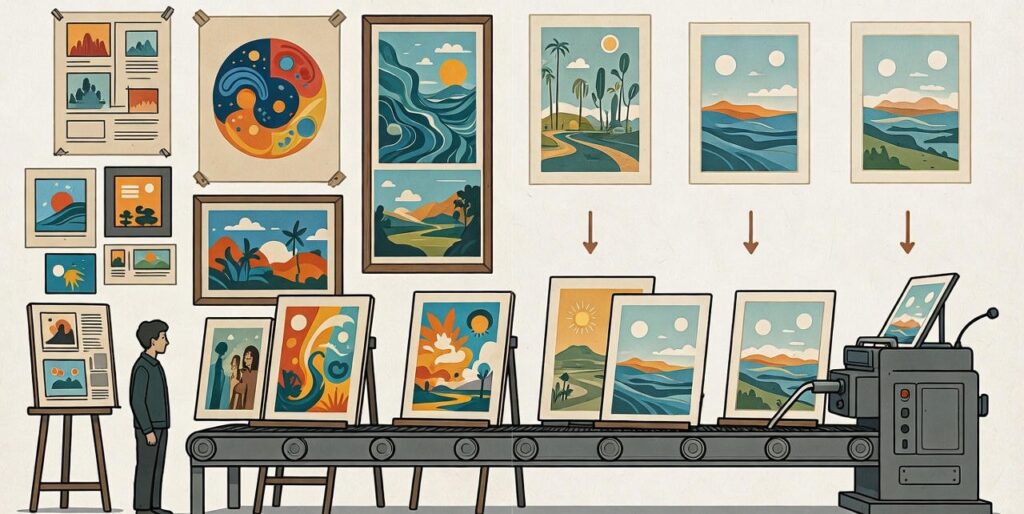
When artists, writers, and animation studios criticize AI, the issue is often misunderstood. The real fear is not copying. It is averaging.
AI does not invent new styles. Instead, it blends existing ones into safe, familiar results optimized to avoid risk. This approach works for filler content, but it is destructive for culture.
Art evolves through mistakes, experiments, and ideas that initially feel uncomfortable. AI avoids all of that by design. As a result, the output looks polished but lacks identity.
Culture without risk becomes decoration.
AI Turned Out to Be Very Physical
Another broken promise involves the idea that AI would remain lightweight and abstract — a digital brain floating somewhere in the cloud.
In reality, AI runs on massive data centers filled with GPUs. Consequently, hardware prices rise, energy consumption increases, and power grids feel growing pressure. Gamers, consumers, and small creators experience this impact directly.
AI is not immaterial. It is industrial, expensive, and resource-hungry. The future did not become cleaner. Instead, it became heavier.
When AI Learns From Itself
One of the most troubling side effects of mass AI content production is model collapse. As AI generates more text, images, and videos, newer systems increasingly train on data produced by older models.
Errors compound. Patterns flatten. Diversity disappears.
Instead of accelerating intelligence, the system risks gradual degradation. The dream of self-improving machines runs into a simple limit: AI is forced to consume its own output.
So Did 20th-Century Dreams Come True?
From a technical perspective, many predictions proved accurate. Machines can write, draw, translate, speak, and convincingly simulate intelligence.
From a human perspective, the outcome looks far less optimistic. Instead of liberation from meaningless work, society experienced saturation. Instead of deeper understanding and wisdom, the dominant result became sheer volume. Meaningful interaction with intelligent systems never arrived, while endless feeds optimized for engagement took its place.
Final Thoughts
Ultimately, the problem was never artificial intelligence itself. The real issue lies in what modern systems chose to optimize. While people imagined a future built around understanding and progress, the reality revolves around clicks, retention, and scale. These priorities conflict by design.
The central question today is no longer how powerful AI will become. It is whether humans can still recognize value and meaning in an environment where most content looks optimized, generated, and disposable.