
The 2026 Pivot: Why Freelance Platforms Are Losing Power — and Where the Real Money Is Now

For more than a decade, freelance platforms like Upwork and Fiverr were the main gateway to remote work.
They allowed millions of people to earn online, build careers, and work with clients from around the world.
But in 2026, something is clearly changing.
Freelancers complain about lower rates, clients complain about spam proposals, and more professionals are quietly moving away from traditional marketplaces. At the same time, new tools powered by AI are making it possible to find clients without using freelance platforms at all.
This does not mean freelance marketplaces are dead.
It means the rules of the game are changing — fast.
This shift is often called the 2026 Pivot, and if you work online, you should understand what is really happening.
The Problem: Why Many Freelancers Feel Platforms Are Getting Worse
Freelance platforms still work, but they are no longer as comfortable as they were five or ten years ago.
The biggest complaints in 2025–2026 are always the same:
- Too many applicants for every job
- Falling prices
- High commissions
- Regional payment restrictions
- AI-generated spam proposals
Let’s look at the main reasons.
Why Some People Make $100/Month Online and Others Make $10,000 — The Real Differences
What Awaits Dropshipping in 2026 — Trends, Truths, and the Future of E-Commerce
1. Proposal Flooding: When Every Job Gets 300 Applications

One of the biggest changes in recent years is the rise of AI-generated applications.
With tools based on APIs from companies like
OpenAI and
Anthropic,
it became very easy to generate custom proposals automatically.
As a result:
- A single job can get 200–500 replies
- Many replies are written by AI
- Clients struggle to find real professionals
- Good freelancers get lost in the noise
This creates frustration on both sides.
Clients spend more time filtering.
Freelancers spend more time applying.
And everyone earns less.
2. Price Pressure and Global Competition
Freelance platforms are global by design.
That used to be an advantage.
Now it also means constant price pressure.
In 2020, a freelancer could compete mostly with people from similar regions.
In 2026, you compete with the entire world.
Typical rate changes many freelancers report:
| Type of work | Avg price 2020 | Avg price 2026 |
|---|---|---|
| Article writing | $40–60 | $10–20 |
| Logo design | $80–120 | $20–40 |
| Simple coding tasks | $200+ | $60–100 |
This does not mean high rates disappeared.
It means the middle segment became crowded.
Beginners work cheap.
Top experts charge premium.
Everyone in the middle feels pressure.
3. Platform Fees and Restrictions
Freelance marketplaces are businesses, and their fees matter more now than before.
Typical conditions:
| Platform | Commission | Notes |
|---|---|---|
| Upwork | ~10% | Paid connects, limits, account reviews |
| Fiverr | 20% | Fixed system, no direct deals |
| Freelancer | ~10% | Bids + fees |
| Toptal | High cut (hidden) | Premium clients, hard entry |
For many freelancers, the problem is not only the fee itself.
It is the feeling that:
- You don’t control the client
- You don’t control the rules
- You can lose access anytime
That is why more people are looking for alternatives.
4. The New Trend: Direct Clients Instead of Platforms
In 2026, one of the biggest changes in freelancing is the growth of direct contracts.
Instead of finding work through platforms, freelancers find clients through:
- X
- personal websites
- cold email
- Discord communities
- niche forums
Why this is attractive:
- no commission
- long-term contracts
- better rates
- more control
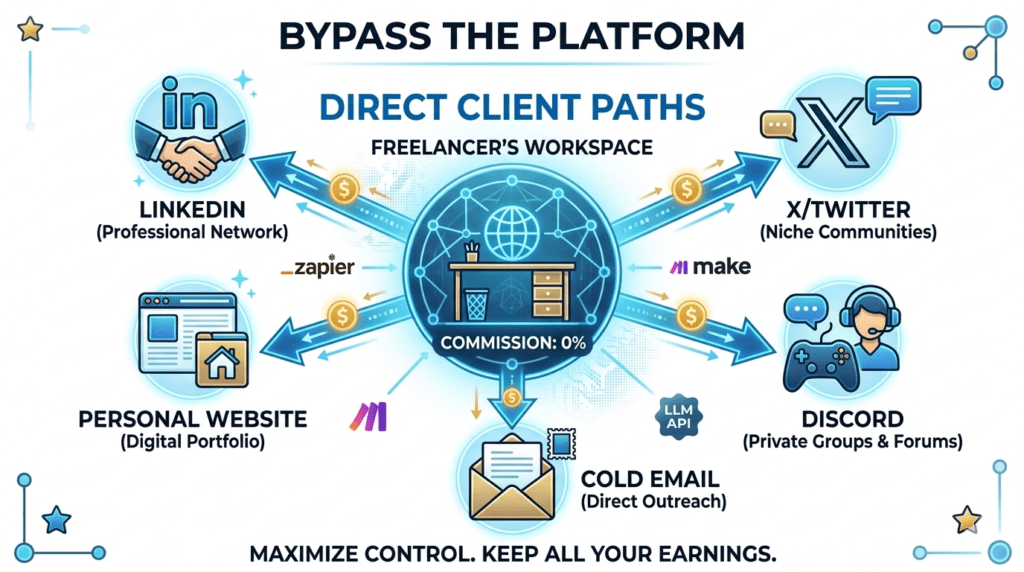
Many experienced freelancers now use platforms only as backup, not as their main source of income.
This is one of the key parts of the 2026 pivot.
5. AI Agents Are Changing How Freelancers Find Work
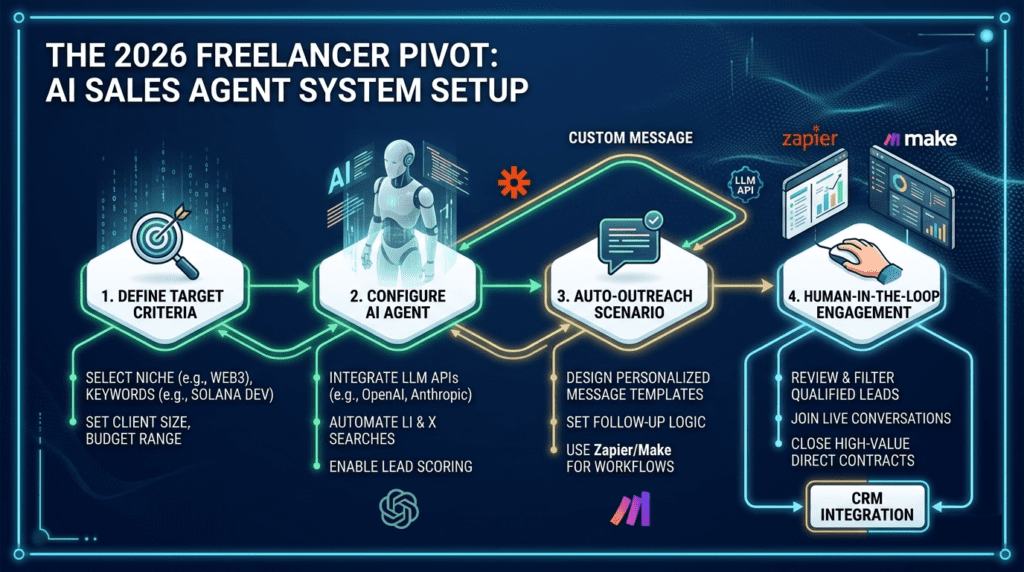
The second big change is automation.
Freelancers are starting to use AI not only for work, but also for finding clients.
This does not mean robots replace freelancers.
It means freelancers use AI as a sales assistant.
Typical setup in 2026:
- AI searches for potential clients
- AI writes outreach messages
- AI filters replies
- freelancer joins only when the lead is real
Tools often used in these systems:
- automation platforms like Zapier
- workflow builders like Make
- LLM APIs
- scraping tools
- CRM integrations
This allows one freelancer to do the work of a small agency.
That is why some people say the future of freelancing is not platforms — it is automation + personal brand.
6. Platform vs Direct vs AI Outreach — Comparison
Here is a simple comparison of the main ways freelancers get work in 2026.
| Method | Commission | USA | Singapore | EU | CIS / Eastern Europe |
|---|---|---|---|---|---|
| Upwork | ~10% | ✔ | ✔ | ✔ | ⚠ possible limits |
| Fiverr | 20% | ✔ | ✔ | ✔ | ⚠ possible limits |
| Freelancer | ~10% | ✔ | ✔ | ✔ | ✔ |
| Direct contracts | 0% | ✔ | ✔ | ✔ | ✔ |
| AI outreach | 0% | ✔ | ✔ | ✔ | ✔ |
⚠ Some regions may face payment or verification issues depending on platform rules.
This is one of the reasons why many freelancers in 2025–2026 prefer direct clients.
7. The Real Situation: Platforms Are Not Dead — But They Are Not the Center Anymore
It would be wrong to say freelance platforms are failing completely.
They still have millions of users.
They still work.
They still bring clients.
But their role is changing.
Today the freelance market looks more like this:
- Platforms → entry level and mass jobs
- Direct clients → main income for professionals
- AI tools → advantage for those who know how to use them
This is the real pivot.
Not a collapse.
Not a revolution.
A shift.
8. Where the Real Money Is in 2026
Freelancers who earn the most today usually combine several things:
✔ direct clients
✔ personal website or portfolio
✔ social media presence
✔ automation tools
✔ niche specialization
Instead of asking:
Where can I find jobs?
They ask:
How can clients find me?
That mindset change is probably the biggest difference between 2016 and 2026.
Final Thoughts
Freelance platforms like Upwork and Fiverr are not disappearing.
But they are no longer the only way to make money online.
In 2026, the freelancers who earn the most are not the ones who send the most proposals.
They are the ones who:
- build a personal brand
- work with direct clients
- use AI as a tool, not a replacement
- and stay flexible as the market changes
That is the real 2026 pivot — and it is already happening.