
Your Job in 2026 vs. 2030: What AI Will Change (And What It Won’t)

The Question Everyone Is Actually Asking
Not “will AI take jobs?” That debate is done.
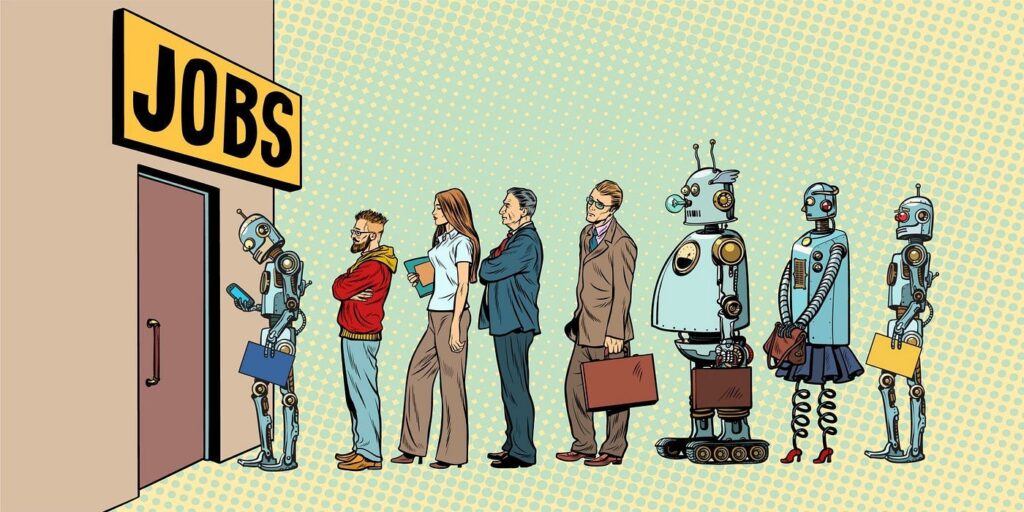
The real question is: whose job, when, and how bad will the transition hurt?
Because right now, in 2026, the effects are real but uneven. Some people are thriving. Some are already feeling the squeeze. And the gap between those two groups is going to widen dramatically before 2030.
This isn’t a piece about robots stealing your lunch. It’s a clear look at what the data actually says — sector by sector, year by year — so you can make smart decisions instead of anxious ones.
Where Things Stand Right Now (2026)
First, a reality check.
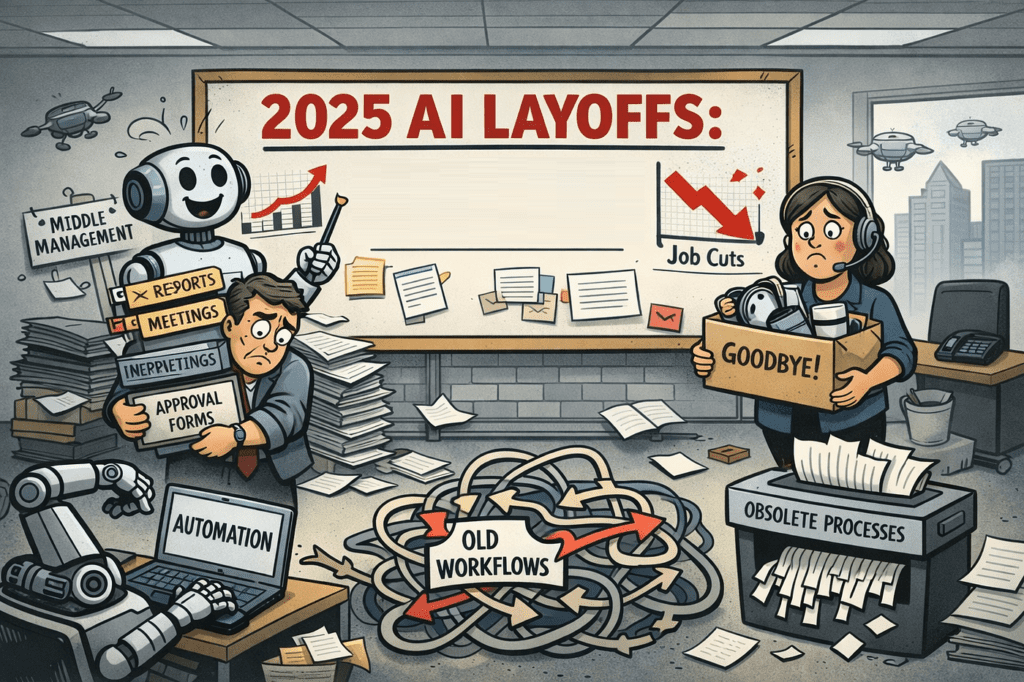
AI contributed to 4.5% of all job losses in 2025, according to compiled data from major labor trackers. In the first six months of 2025 alone, nearly 78,000 tech jobs were directly attributed to AI-driven restructuring.
But here’s what often gets buried in the scary headlines:
The World Economic Forum’s Future of Jobs Report projects 170 million new roles created by 2030 against 92 million displaced — a net gain of 78 million jobs worldwide.
Check it: WEF — Future of Jobs Report
Goldman Sachs puts potential displacement at 6–7% of the U.S. workforce if AI adoption goes wide and deep — but also estimates the impact is “transitory,” historically disappearing within two years as new roles absorb displaced workers.
So: disruption is real. Apocalypse is not. The picture in between is where it gets complicated.
Canva AI vs Adobe Express vs Figma: Best Design Tool for Non-Designers in 2026?
Why Every Gadget Looks the Same in 2025 — and Why That’s a Problem
The Jobs Already Feeling It
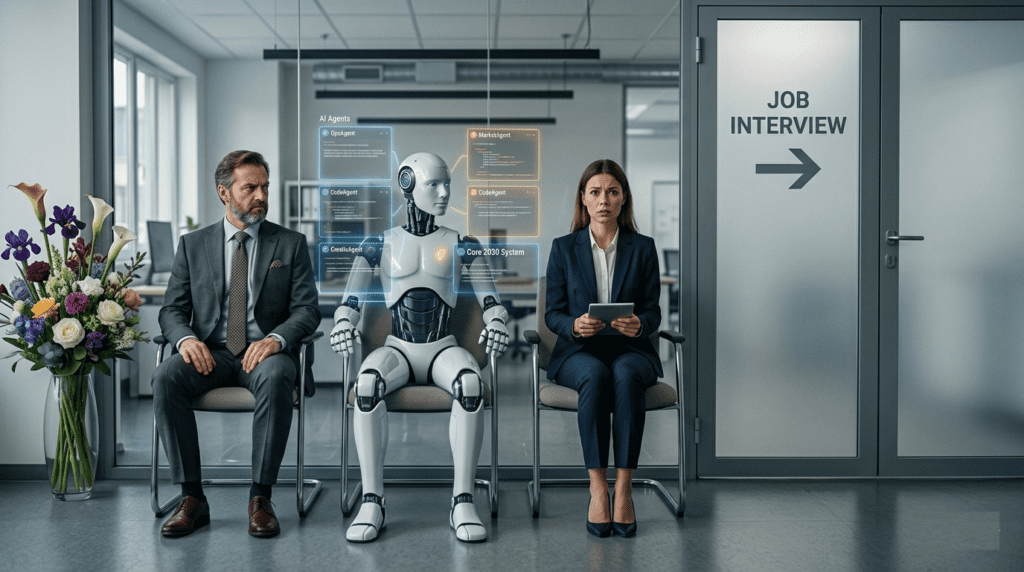
The counterintuitive truth? AI hit white-collar cognitive work first, not factory floors.
The highest automation risks right now are concentrated in roles that involve predictable, rules-based information processing — not heavy lifting.
| Role | Risk Level | Key Pressure |
|---|---|---|
| Data entry / admin clerks | Very High | Already being automated at scale |
| Customer service reps | Very High | 80% displacement risk flagged |
| Bank tellers | High | Projected -15% by 2033 |
| Medical transcriptionists | High | Speech-to-text AI replacing them |
| Junior copywriters / translators | High | Demand on freelance platforms fell 30% since 2022 |
| Entry-level software developers | Moderate-High | Hiring slowed among age 22–25 group |
| Credit analysts | Moderate | AI processes financial risk faster |
Brookings found 6.1 million U.S. workers sit in a particularly rough spot — high AI exposure and low adaptive capacity (limited savings, limited skill transferability, limited network to find new work fast).
These are real people, and the transition is already happening to them, not as a future threat but as a present reality.
The Jobs That Are Actually Growing
Skilled trades are having a moment that almost nobody predicted.
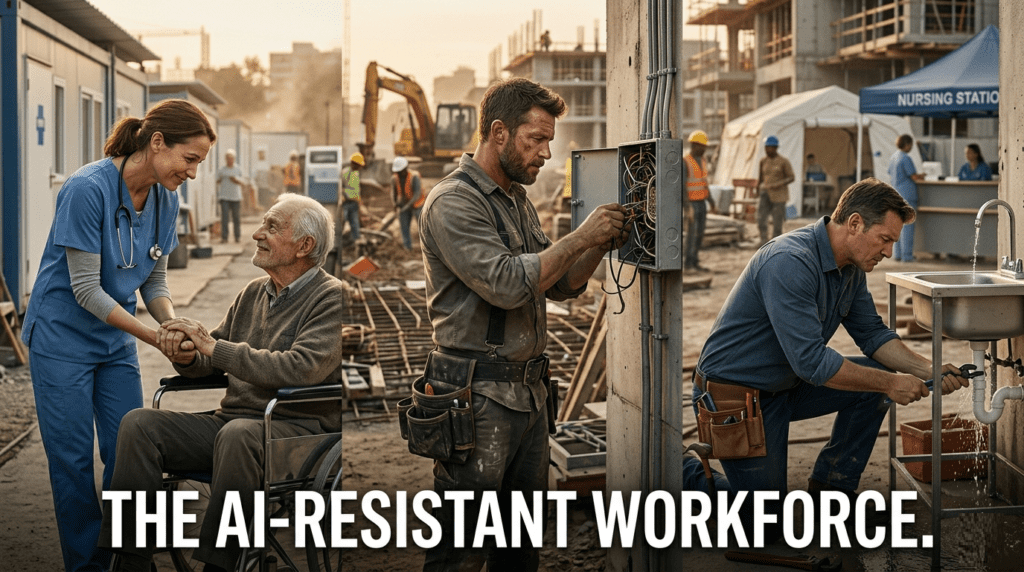
An electrician can’t be prompted. A plumber can’t be deployed via API. Pipefitters, HVAC technicians, construction managers — these roles require physical judgment in unpredictable environments that current AI and robotics simply cannot navigate cost-effectively (Check it: Brookings — AI and the Future of Work).
Add to that the sheer scale of AI infrastructure buildout: data centers, power grids, fiber networks. All of it requires humans on the ground.
Healthcare is the other giant. More than 34 million new healthcare roles are expected by 2030, driven by aging populations. Nurses, physical therapists, mental health counselors, surgeons — these roles have 85–98% AI-resilience scores in current modeling. Not because the tools aren’t smart, but because 60% of patients say they would feel uncomfortable if their doctor relied on AI for their care. Trust is a human product.
On the tech side: cybersecurity analysts (+32% projected through 2032), AI infrastructure roles, and data specialists are expanding fast. Software developers overall are still growing (+17.9% projected through 2033) even as junior entry-level work shifts.
The pattern is consistent: physical unpredictability + emotional trust + judgment in incomplete information = AI-resistant.
What Changes Between 2026 and 2030
Here’s where it gets important.
2026 is mostly about AI augmenting existing roles. Most people using AI are doing their jobs faster, not losing them.
2027–2030 is where the structural shift accelerates, according to the research consensus. Autonomous systems in transportation and manufacturing reach commercial scale. Agentic AI — tools that plan and execute multi-step tasks without human prompting — moves from enterprise pilots to mainstream deployment. Gartner projects that 40% of enterprise applications will use task-specific AI agents by 2026, compared to less than 5% in 2025. That compounding effect hits the labor market differently than what we’ve seen so far.
McKinsey estimates 14% of the global workforce will need to change careers entirely by 2030. Not change tasks — change careers.
That’s one in seven workers.
The critical window isn’t 2030 — it’s the next 18 to 36 months. The people who navigate this well are already moving.
What AI Actually Cannot Replace
Here’s the honest answer — and it matters to say it clearly.
AI is genuinely terrible at:
1. Navigating physical unpredictability. A burst pipe in a 1940s building is different every time. A patient who collapses mid-surgery requires improvisation. Current robotics and AI cannot handle open-ended physical environments at competitive cost.
2. Accountability and trust. Lawyers score 100/100 on AI-resistance in current modeling, with only 29% automation likelihood — not because legal research can’t be automated (it can), but because a client signing documents worth millions needs a human who is legally and personally accountable. Same logic applies to therapists, executives, and anyone whose job involves being trusted with something serious.
3. Genuine creative judgment. AI generates content. It cannot decide what means something. Strategic direction, brand narrative, cultural resonance — these require human intention and contextual understanding that no model currently replicates reliably.
4. Emotional presence. A study in the Journal of Medical Ethics showed patients recover better when they feel understood. That’s not a soft metric — it’s a clinical outcome. AI can offer data. Humans offer reassurance. They are not interchangeable.
The Skill Premium Is Real
One number worth keeping: 56% wage premium for workers who use AI effectively, according to PwC research.
Not workers who do AI as a job. Workers in any field — marketing, nursing, law, logistics — who integrate AI tools into their workflow and use them competently.
This is the practical takeaway that gets skipped in most coverage of this topic.
The AI transition is not primarily a story about jobs disappearing. It’s a story about leverage. People who know how to use these tools are doing the work of 1.5 or 2 people, getting paid accordingly, and making themselves structurally harder to displace.
The alternative — ignoring the tools entirely — is exactly what makes someone easy to replace (Check it: PwC — AI Jobs Barometer).
Final Thoughts
The fear around AI and jobs is understandable. The data justifies concern, just not the specific kind of apocalyptic concern that dominates the conversation.
What’s actually happening is a compression of the transition period. Changes that might have taken 20 years are happening in 5. That’s genuinely disruptive for specific people in specific roles, and it’s not fair to wave that away.
But the headline number — net 78 million jobs created — doesn’t lie either.
The difference between who benefits and who gets left behind comes down to timing and adaptability. The roles that are safe aren’t the ones that are immune to AI. They’re the ones where human judgment, trust, and physical presence have value that scales with better tools, not against them.
The window to position yourself on the right side of that line is now. Not 2030.