
5 Coins Everyone Forgot — But Might Explode in 2026

ZyntoHub Crypto Analysis · November 2025
There’s a thin line between “dead projects” and “sleeping giants.”
Many of the coins left behind after 2021 aren’t gone — they’re quietly rebuilding, refocusing, or waiting for the right narrative to catch up.
In a market shifting from speculation to real usage, 2026 could be the year some of these forgotten names reclaim their place.

Here’s our updated analysis on five coins everyone forgot — but that might just surprise you.
(This is research, not financial advice.)
1. Arweave (AR) — The Return of the “Permaweb”

Arweave was once the poster child of permanent storage — a solid concept during the 2021 data-hype boom, when it reached over 200 TB of archived data on-chain but lacked everyday use.
Today, the focus has shifted: Arweave’s new AO layer turns static storage into programmable, verifiable compute.
It’s no longer about saving files forever — it’s about running logic on immutable data.
If AI models, historical datasets, and digital identity records start depending on unalterable infrastructure, Arweave could quietly become the backbone of the decentralized web.
Catalysts:
AO developer adoption, bridges to L2 ecosystems like Base and Optimism, and integration with AI indexing tools.
Metrics to watch: total stored data, AO transactions per day, number of active dApps.
Risks:
Adoption remains slow, and competition from Filecoin and IPFS is growing — both now expanding into the same compute-enabled storage layer.
Invalidation:
If AO fails to attract real workloads or fees stay flat, the “Permaweb 2.0” vision collapses back into cold archive storage.
The Sovereign Holder’s Manifesto: Wallets, Tools, and the Biology of Crypto Success
“The Invisible Ledger”: How Blockchain is Quietly Running the World Outside of Finance in 2026
2. Helium (HNT) — From Ghost Network to DePIN Comeback
Helium once had over 900 000 active hotspots worldwide in 2021, but almost no one used the network’s data.
That mismatch killed its hype — until the 2023 migration to Solana and the birth of Helium Mobile.
Now the project is refocusing on real-world usage: selling data connectivity, not mining tokens.
If 2026 brings corporate or municipal deployments, Helium could become the first DePIN network with measurable B2B traffic and stable revenue.
Catalysts:
MVNO partnerships and data-credit demand, 5G coverage expansion, IoT adoption in logistics and smart cities.
Metrics to watch: active hotspots, data transferred (GB), Helium Mobile subscribers.
Risks:
High maintenance costs and user churn remain threats, while Render, Akash and other DePIN projects compete for investor attention in the “real-world infrastructure” narrative.
Invalidation:
If data usage doesn’t scale beyond token speculation, HNT stays a nostalgia piece rather than a utility network.
3. Tezos (XTZ) — The Quiet Layer-1 That Never Stopped Building
Back in 2021, Tezos looked stable yet uninspiring — roughly USD 2 billion TVL and a handful of NFT deals, then silence.
But under the radar, it kept upgrading.
By 2025, it rolled out Etherlink, an EVM-compatible Layer 2 that connects seamlessly to Ethereum, and improved rollups for speed and cost.
If 2026 delivers visible adoption — loyalty programs, tokenized assets, creative or gaming projects — Tezos could evolve from “the academic chain” to the reliable L1-plus-L2 hybrid enterprises actually use.
Catalysts:
Etherlink integrations, brand-driven NFT programs, better developer incentives, stable rollup infrastructure.
Metrics to watch: daily L2 transactions, TVL, active addresses.
Risks:
Marketing silence is still a curse, and Starknet, Optimism, and other L2s dominate mindshare.
If Tezos fails to attract builders or liquidity, even flawless tech won’t save its relevance.
Invalidation:
Flat L2 activity and no visible use-cases — it remains technically elegant but commercially invisible.
4. THORChain (RUNE) — Cross-Chain Liquidity That Works
In 2021, THORChain processed over USD 1 billion in native swaps, proving it could bridge chains without wrapped tokens — but then lost momentum after security incidents.
Now it’s quietly back, positioning itself as the liquidity router for a fragmented multi-chain world.
With BTC Layer-2s (Stacks, BitVM, Runes) emerging and liquidity scattering across networks, THORChain’s natively pooled swaps could become indispensable for seamless value transfer.
Catalysts:
Bitcoin L2 adoption, wallet integrations (XDEFI, Ledger), and the rise of yield-bearing LP products.
Metrics to watch: daily swap volume, pool depth, fees generated.
Risks:
Security remains the biggest wildcard, and bridges like Synapse, Axelar, and LayerZero compete for the same liquidity.
If a major exploit happens, confidence — THORChain’s true asset — could vanish overnight.
Invalidation:
Declining swap volume or another security breach would end its role as cross-chain middleware.
5. Filecoin (FIL) — From Storage to AI Infrastructure

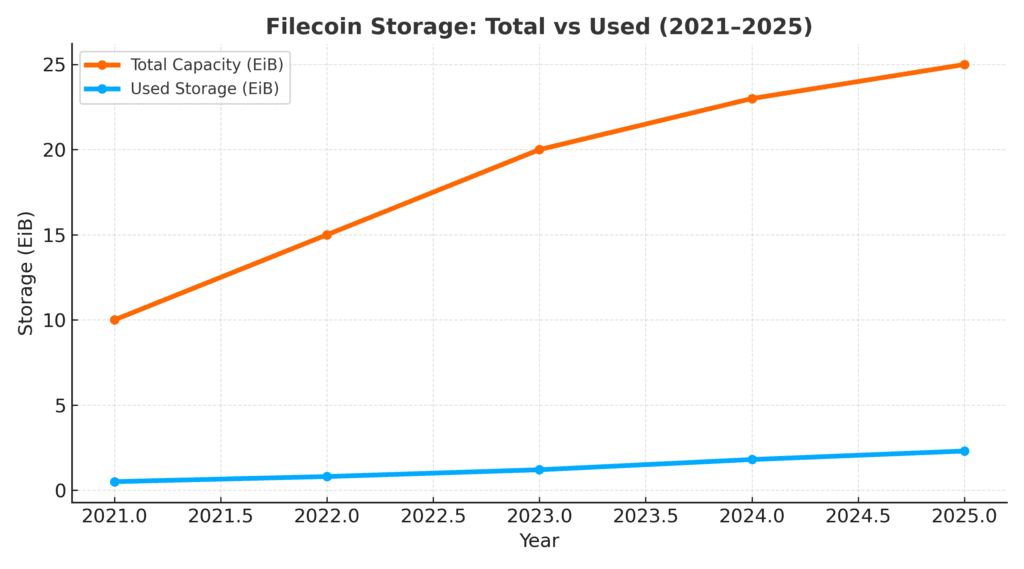
During the 2021 bull run, Filecoin boasted over 10 EiB of storage capacity, yet most of it sat unused — a triumph of scale without substance.
Now it’s aiming higher: turning its massive network into a compute-over-storage layer for decentralized AI and data pipelines.
With the Filecoin Virtual Machine (FVM) and partnerships in data marketplaces, FIL is evolving from cloud competitor to infrastructure backbone for AI training and dataset hosting.
Catalysts:
Adoption of compute-over-storage, enterprise dataset deals, integrations with inference networks like Bittensor or Ritual.
Metrics to watch: active storage deals, compute jobs executed, provider revenue.
Risks:
UX complexity, enterprise friction, and competition from centralized giants (AWS, Google Cloud) and decentralized peers like Arweave or Crust.
Invalidation:
If real clients don’t show up and compute remains experimental, Filecoin risks being remembered only for its 10 EiB headline.
Final Thought — What 2026 Might Look Like
2026 won’t be about hype; it’ll be about proof.
Each of these networks already had its cycle, its fall, and its rebuild.
The question now is simple — can they translate technology into measurable adoption?
If even two of them succeed, the narrative of “forgotten coins” might flip completely.
ZyntoHub will be watching who delivers real metrics, not slogans.