
“The Invisible Ledger”: How Blockchain is Quietly Running the World Outside of Finance in 2026

The Quick Verdict: Is Blockchain Finally Useful?
Yes. In 2026, blockchain has successfully transitioned from a “solution looking for a problem” to the backbone of global trust. The winners aren’t decentralized banks; they are supply chains, healthcare systems, and luxury brands. If you can scan a QR code and see the exact chemical composition of your medicine or the carbon footprint of your shirt, you are using 2026 blockchain tech.
2026: The Non-Financial Blockchain Landscape
| Industry | Primary Use Case | Real-World “Anchor” (2026) | Efficiency Gain |
| Luxury Goods | Anti-Counterfeiting | LVMH & Prada (Aura Consortium) 🟢 | 99% Fraud Reduction |
| Healthcare | Patient Data Twins | Digital Health Twin Network 🟢 | Zero Data Fragmentation |
| Supply Chain | Fibre-to-Retail Tracking | Fjällräven / OTB Group 🟢 | Full ESG Compliance |
| Governance | Immutable E-Voting | Switzerland/Estonia State Tech 🟡 | Tamper-proof Democracy |
| Agriculture | Farm-to-Table Safety | Walmart / IBM Food Trust 🟢 | Surgical Recalls (Minutes) |
| Diamonds | Conflict-Free Proof | De Beers (Tracr) 🟢 | Ethical Sourcing Guarantee |
1. The Luxury “Digital Passport”
In 2026, buying a Louis Vuitton or a Rolex without a blockchain certificate is like buying a car without a title.
- The Logic: Physical certificates can be forged. A Digital Passport on a private blockchain is immutable. It tracks the item from the workshop to every subsequent owner.
- The Anchor: The Aura Blockchain Consortium (LVMH, Prada, Cartier) now covers over 40 million products. Second-hand markets like Vestiaire Collective now refuse high-end listings without a verified on-chain ID.
The Sovereign Holder’s Manifesto: Wallets, Tools, and the Biology of Crypto Success
NFTs vs Tokens vs Coins: The Actual Differences Most People Still Get Wrong
2. Healthcare: The “Digital Health Twin”
The era of carrying paper medical records or waiting for a hospital to “fax” your data is over.
- The Logic: Blockchain creates a decentralized “index” of your medical history. Instead of hospitals owning your data, you own the key.
- The Anchor: By 2026, the cost of a medical data breach has climbed to $7.4M. Hospitals have moved to blockchain-based “Zignuts” style architectures where patient records are tamper-proof and instantly accessible by authorized doctors globally.
3. Supply Chain: The Death of “Greenwashing”
In 2026, saying your product is “sustainable” isn’t enough—you have to prove it through Fibre-to-Retail Traceability.
- The Logic: Traditional supply chains are opaque. Blockchain records every step: where the cotton was picked, which factory dyed it, and how much CO2 the shipping generated.
- The Anchor: Fenix Outdoor (Fjällräven) now uses “Fibercoin” technology to provide full-scale transparency. If the chain is broken, the product loses its “Sustainable” badge, which in 2026 means losing the customer.
The “God” Complex: Why Centralized Systems are Failing
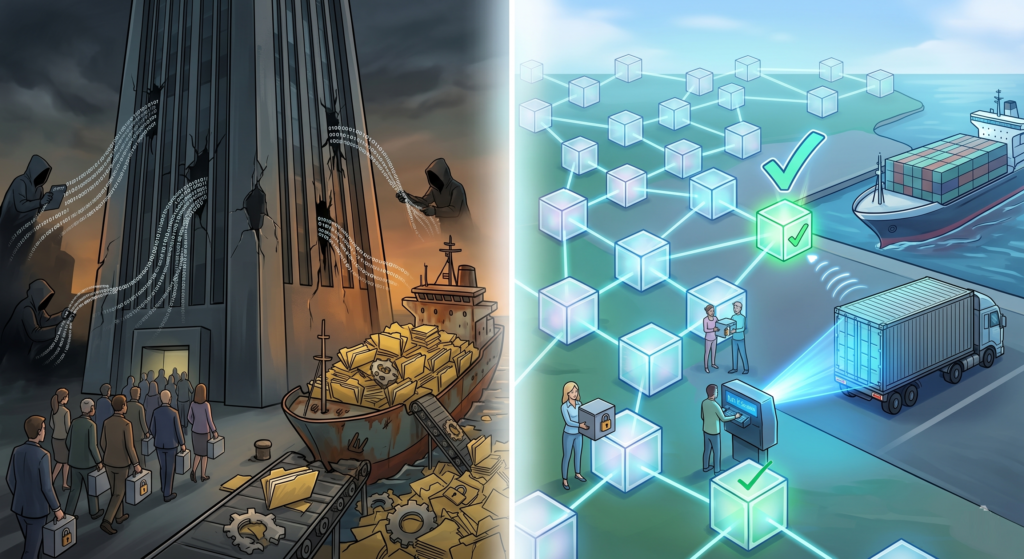
The reason blockchain is winning in 2026 isn’t because it’s “cool,” but because centralized trust has collapsed.
- The Trust Gap: After the massive data leaks of 2024-2025, people no longer trust corporations to hold their private data.
- The Efficiency Gap: Cross-border supply chain paperwork used to take weeks. In 2026, smart contracts execute the moment a shipping container is scanned by an IoT device at the port.
Your 2026 Blockchain Strategy: How to Spot a Real Project
If you are looking at a project and want to know if it’s “Finance Slop” or a “Real Asset,” ask these three questions:
- Does it solve a physical problem? (e.g., stopping fake drugs or tracking cobalt).
- Is there a “Real World Asset” (RWA) involved? (e.g., a handbag, a medical record, or a diamond).
- Who are the partners? (If it’s IBM, LVMH, or a government, it’s infrastructure. If it’s a celebrity influencer, it’s a scam).
Final Thoughts: The Invisible Revolution
Blockchain in 2026 has become like the “HTTPS” of the internet. You don’t think about it, and you don’t need to understand the cryptography to use it. It is the silent layer of truth that ensures the food you eat is safe, the clothes you wear are ethical, and your medical data is yours. The “Crypto Winter” was just the rain needed to wash away the speculators and let the actual builders grow the future.