
Why 90% of Crypto Traders Lose Money — According to Behavioral Economics

It’s Not the Market — It’s Human Behavior
Cryptocurrency markets are often described as irrational, manipulated, or chaotic. But behavioral economics suggests a different explanation — one that is far less comfortable.
Most crypto traders don’t lose money because they lack information.
They lose money because human psychology is poorly suited for fast, emotional, 24/7 markets.
This isn’t a crypto-specific problem. Similar patterns were observed in stock trading long before Bitcoin existed. Crypto simply amplifies the same behavioral mistakes, making losses more frequent and more severe.
Behavioral economics doesn’t ask how people should behave.
It studies how people actually behave under pressure, uncertainty, and temptation.
And crypto is the perfect stress test for the human mind.
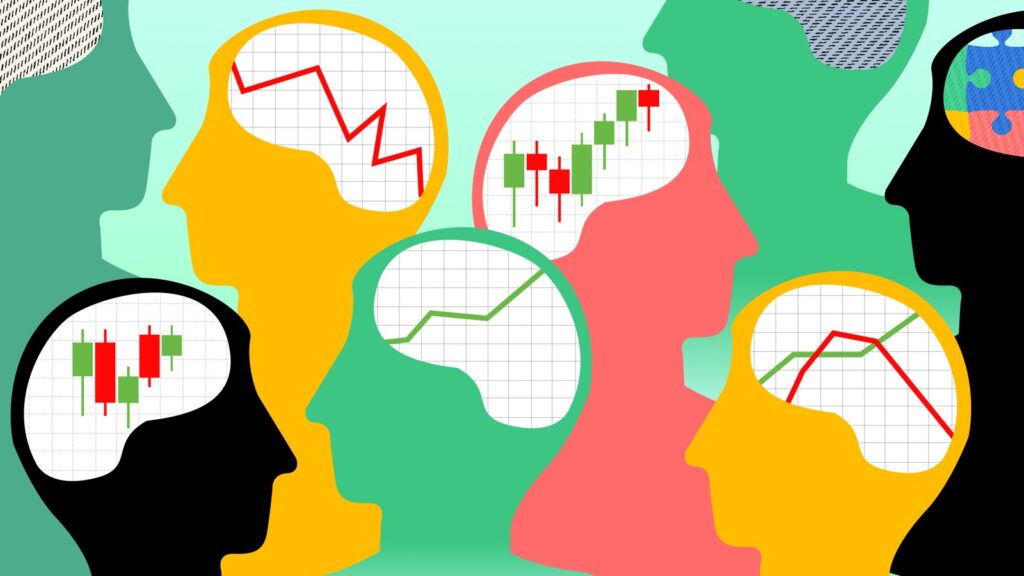
Crypto Markets Expose Every Cognitive Bias at Once
Traditional finance already struggles with human irrationality. Crypto removes many of the brakes that normally slow bad decisions:
- No trading hours
- Extreme volatility
- Constant social media noise
- Little regulation
- Immediate execution
The result is a market environment where emotions overpower logic faster than most people realize.
The Sovereign Holder’s Manifesto: Wallets, Tools, and the Biology of Crypto Success
“The Invisible Ledger”: How Blockchain is Quietly Running the World Outside of Finance in 2026
1. Overconfidence Bias: “I’m Smarter Than the Market”
One of the most documented findings in behavioral finance is overconfidence.
Studies by Barber and Odean (University of California) showed that:
- Individual traders consistently overestimate their ability
- The most active traders perform the worst
- Frequent trading reduces returns over time
Crypto makes this worse.
A few early wins — often driven by luck — convince traders they have skill. That confidence leads to:
- Larger position sizes
- Higher leverage
- Less risk management
One profitable trade creates belief.
The market eventually punishes that belief.
2. FOMO: Buying Emotion, Not Value

Fear of Missing Out (FOMO) is not a character flaw — it’s a well-studied psychological response.
Behavioral research shows that:
- Humans experience stronger emotional pain from missing gains than from small losses
- Social proof increases perceived value, even when fundamentals don’t change
In crypto, price spikes are amplified by:
- YouTube thumbnails
- Influencer narratives
By the time an asset reaches peak visibility, it often reaches peak retail entry — historically the worst moment to buy.
3. Loss Aversion: Why Traders Hold Losing Positions Too Long
Daniel Kahneman and Amos Tversky demonstrated that:
- Losses feel roughly twice as painful as equivalent gains feel pleasurable
In trading, this leads to a predictable pattern:
- Traders sell winners early to “lock profits”
- Traders hold losing positions, hoping to “get back to break-even”
This behavior is consistently observed across:
- Stock markets
- Forex
- Crypto
Crypto volatility simply accelerates the damage.
Traders don’t hold losers because they’re ignorant.
They hold them because realizing a loss feels like admitting failure.
4. Confirmation Bias: The Echo Chamber Effect
Once traders form a belief, they unconsciously seek information that confirms it.
In crypto, this is amplified by:
- Algorithmic feeds
- Community-based narratives
- Labeling criticism as “FUD”
Instead of analysis, many traders engage in belief reinforcement:
- Following only bullish accounts
- Ignoring contradictory data
- Treating price movement as validation
Most traders don’t analyze markets.
They curate reassurance.
5. Action Bias: Trading Because Doing Nothing Feels Wrong
Action bias refers to the tendency to act even when inaction is the better choice.
Crypto markets encourage constant activity:
- Prices move every second
- Apps send notifications
- Charts are always open
Research in behavioral economics shows that:
- Excessive action reduces performance in uncertain environments
- Waiting often feels psychologically worse than making a mistake
In crypto, overtrading is often more dangerous than being wrong.
6. Social Proof: “Everyone Else Is Buying”
Humans are social decision-makers.
When many people appear to agree on something, the brain interprets that as information — even when it isn’t.
Crypto communities intensify this effect:
- Viral narratives
- Memes as financial signals
- Influencers substituting for analysis
But popularity and profitability are not the same thing.
By the time “everyone knows,” the opportunity is usually gone.
7. Why Crypto Makes These Biases Worse Than Traditional Markets
Compared to stocks, crypto markets are:
- Faster
- Less regulated
- More narrative-driven
- More emotionally charged
Traditional markets impose friction:
- Trading hours
- Institutional checks
- Reporting requirements
Crypto removes most of that friction — and with it, the psychological safety rails.
The result is not a broken market, but a brutally honest one.
Who Actually Makes Money Long-Term?

Behavioral data suggests it’s not:
- The most active traders
- The most confident voices
- The most emotional participants
Instead, long-term survivors tend to be:
- Low-frequency decision-makers
- Rule-based investors
- People who accept uncertainty
- Those comfortable with doing nothing
This mirrors findings from decades of financial research — crypto simply repeats the lesson faster.
The Market Isn’t Irrational — Humans Are
Crypto doesn’t destroy people financially.
It reveals something uncomfortable:
humans are not naturally equipped to handle speed, volatility, and constant temptation.
Behavioral economics doesn’t explain why markets fail.
It explains why traders do.
Until that reality is understood, the statistic won’t change — whether it’s 90% or 95%.
Final Thoughts
This isn’t an argument against crypto.
It’s an argument against ignoring human behavior.
Technology evolves faster than psychology.
And markets don’t reward confidence — they reward discipline.