
NFT Madness — $100K JPEGs Now Worth Nothing

The rise, the mania, the collapse — and the numbers behind it.
In 2021, NFTs weren’t just digital images.
They were identity, culture, status, and — for a shocking moment — an entirely new asset class. People were paying $50,000, $80,000, even $500,000 for cartoon animals and pixel avatars. Crypto conferences became fashion shows for profile pictures. Twitter feeds were filled with neon monkeys, pixel punks, and anime characters with “rare traits” that supposedly justified a price tag of a luxury apartment.
But the mania didn’t just cool off — it imploded.
And today, some of the most iconic NFTs of that era have lost 70–99% of their value.
Here is what really happened — with real prices, real data, and real stories.
Bored Ape Yacht Club — From Superstar Status to a 95% Crash
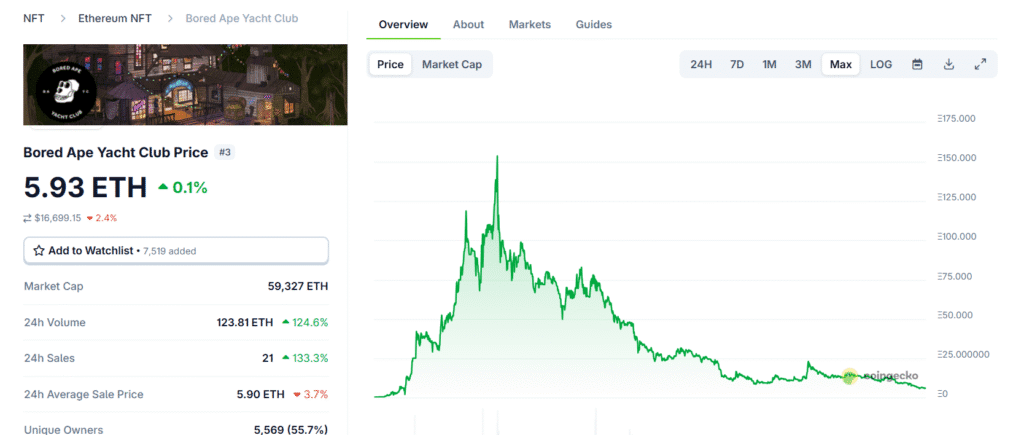
Bored Apes were once the pinnacle of Web3 culture. Celebrities like Madonna, Eminem, Neymar, Snoop Dogg, and Justin Bieber proudly bought in, tweeting their Apes like trophies.
At its peak:
- ATH floor price: ~152 ETH (~$429,000)
This wasn’t a cartoon.
This was a “membership,” a status symbol, an investment — or at least that’s what people believed.
But the promises (metaverse, exclusive events, brand deals) didn’t materialize fast enough. Liquidity dried up. Interest faded.
Today:
- Current floor: ~5.5–6 ETH (~$15,000)
That’s a staggering –96% decline.
Justin Bieber’s $1.3M Ape?
Now worth around 8 ETH (~$20k).
The fall was not subtle — it was catastrophic.
The Sovereign Holder’s Manifesto: Wallets, Tools, and the Biology of Crypto Success
“The Invisible Ledger”: How Blockchain is Quietly Running the World Outside of Finance in 2026
CryptoPunks — Still Valuable, But Not Untouchable
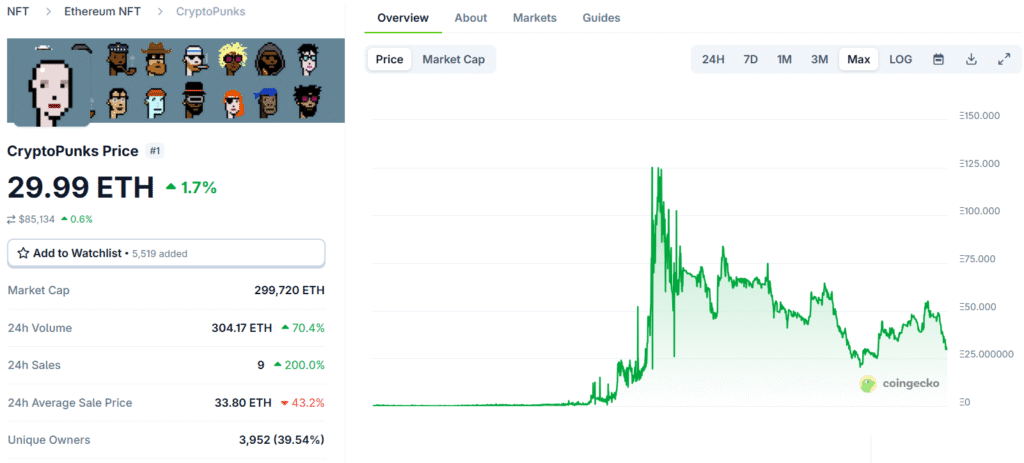
CryptoPunks were supposed to be “the Bitcoin of NFTs.”
And to be fair, they’re one of the few collections that didn’t go to zero or close to it.
At their peak:
- ATH floor: 120 ETH (~$420,000)
Punks weren’t promises — they were history. The first major NFT PFP project. The template for everything that came after.
But even legends bleed in a speculative collapse.
Today:
- Current floor: ~30 ETH (~$85,000)
A drop of ~75%.
That’s still huge — but Punks survived better than any other major NFT project. They didn’t die — they shrank back into a collector’s niche.
Azuki — A Beautiful Collection With a Brutal Crash
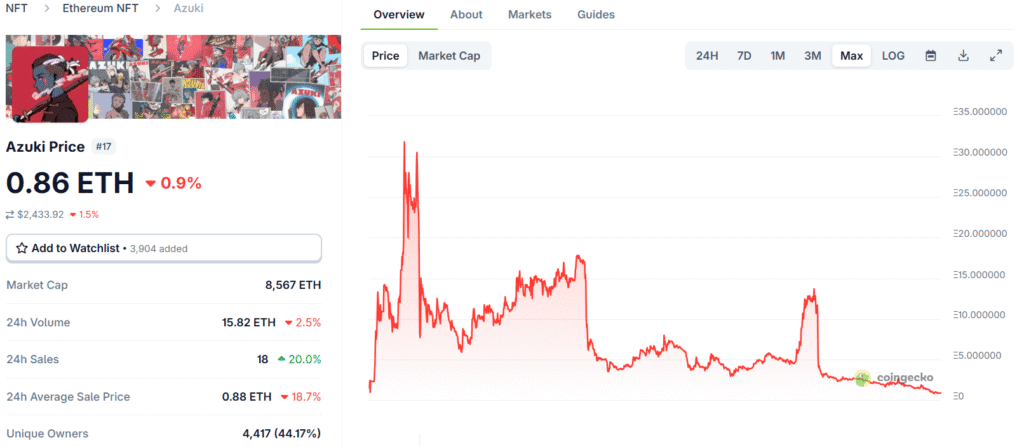
Azuki was one of the most visually polished, aesthetically refined NFT brands ever created. Its anime-inspired style built an intense community. For many holders, Azuki wasn’t an investment — it was an identity.
At its peak:
- ATH floor: 33 ETH (~$110,000)
But trust is fragile.
When reports revealed that the founder “Zagabond” had previously abandoned multiple NFT projects, confidence evaporated overnight.
Today:
- Current floor: ~1.2–1.3 ETH (~$3,000)
That’s a collapse of –96%, almost identical to BAYC.
Once a top-tier “blue chip,” Azuki became one of the most painful examples of how reputation alone cannot hold up the market.
Moonbirds & Doodles — Utility Promises That Didn’t Arrive
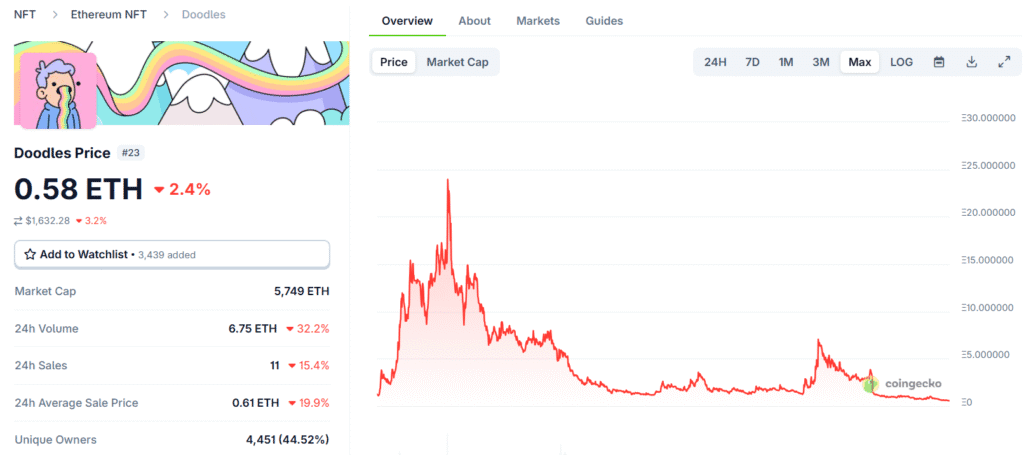
During the hype, “utility NFTs” became the next big promise.
Moonbirds and Doodles were the poster children of this trend — beautifully branded, backed by respected founders, and marketed as the next generation of digital membership clubs.
But the execution lagged, roadmaps felt stretched, and communication missteps hurt trust.
Moonbirds:
- Peak: 38 ETH
- Now: < 1 ETH
Drop: ~–97%
Doodles:
- Peak: 23 ETH
- Now: ~1 ETH
Drop: ~–95%
They didn’t “rug.”
They simply couldn’t deliver at the speed the market demanded.
And hype-based ecosystems cannot survive without hype.
Pixelmon — The $70M Meme Disaster (“Kevin”)
If one project summarizes everything wrong with the NFT boom, it’s Pixelmon.
The pitch?
A AAA open-world Web3 game.
The mint price?
3 ETH (~$10,000) per NFT.
The result?
Horrifyingly bad 3D models that instantly turned into memes.
The accidental mascot “Kevin” became a symbol of the whole NFT bubble — expensive, absurd, and completely unserious.
Current prices hover around:
- 0.2 ETH
Drop: –95%
The collapse wasn’t surprising.
But it was iconic.
Metaverse Land — From Luxury Property to Empty Sandbox
In 2021, people genuinely paid real estate prices for digital plots of land in Sandbox, Decentraland, and Otherside.
Some parcels sold for more than actual apartments.
But virtual land isn’t like real land — it has no geographic limitation. Developers can simply expand the map.
When the metaverse hype fizzled, so did land prices.
Sandbox LAND:
- ATH: 4–5 ETH
- Now: ~0.2 ETH
Drop: –95%
Otherside:
- ATH: 7.5 ETH
- Now: ~0.45 ETH
Drop: –94%
There was no shortage of digital land.
Only a shortage of buyers.
Celebrity NFTs — The Fastest-Collapsing Segment of the Market
When celebrities joined the NFT gold rush, the hype exploded — and so did the crashes.
Most celebrity collections now sit at:
- $10–$50 floor
- or complete zero volume
Logan Paul’s CryptoZoo was the worst offender — a project now investigated for fraud and lawsuits, with NFTs basically worthless.
Celebrity hype was a sugar rush.
When fame exited, liquidity vanished instantly.
Why Did NFTs Collapse So Hard?
1. Zero utility (in most cases)
The majority of NFTs offered no real product or function.
2. Hype-based market structure
The price depended entirely on public attention — not actual value.
3. Illusion of scarcity
“10,000 items” sounds limited until 10,000 more are minted next week.
4. Wash trading inflated prices
Fake volume created fake confidence.
5. No liquidity
Unlike crypto, NFTs cannot be instantly sold.
When buyers disappear — the market dies.
6. Investor fatigue
Communities got tired of roadmaps, promises, and delays.
Final Thoughts
NFTs weren’t a scam — they were a culture bomb, a digital gold rush, a once-in-a-generation speculative experiment.
But like every mania before them, they depended not on technology, but on belief.
When the belief cracked, so did the prices.
Some collections — like CryptoPunks — will likely survive as historic artifacts.
But most NFTs will remain abandoned tokens on the blockchain, reminders of a time when digital pictures briefly became luxury investments.
The madness wasn’t buying art.
The madness was thinking it could only go up.