
Why AI Still Can’t Replace Game Designers

And Why Every Attempt Only Makes Games Feel Worse
The gaming community isn’t afraid of AI.
That fear, however, has already passed.
What players feel now is something closer to irritation — and sometimes outright anger. Not because machines are getting smarter, but because games are starting to feel emptier. Polished, technically impressive, content-rich… and strangely hollow.
People don’t complain that AI exists.
Instead, they complain when a game feels like it was made without intention.
For that reason, this difference matters more than studios realize.
Players Recognize “Fake” Instantly — Even If They Can’t Explain Why

When a game feels off, players rarely say “this was generated by AI.”
They say things like:
“This feels soulless.”
“Everything looks right, but nothing sticks.”
“I don’t trust this studio anymore.”
That reaction isn’t emotional overreaction. It’s pattern recognition.
Games are not judged the way software is judged. They’re judged the way music, films, and stories are judged — by taste. By rhythm. By restraint. By moments where the creator clearly chose one uncomfortable option over ten safe ones.
AI doesn’t choose — it calculates.
Because of that, players feel the difference immediately.
Canva AI vs Adobe Express vs Figma: Best Design Tool for Non-Designers in 2026?
Why Every Gadget Looks the Same in 2025 — and Why That’s a Problem
The Larian Example: Why Some Studios Refuse AI on Purpose
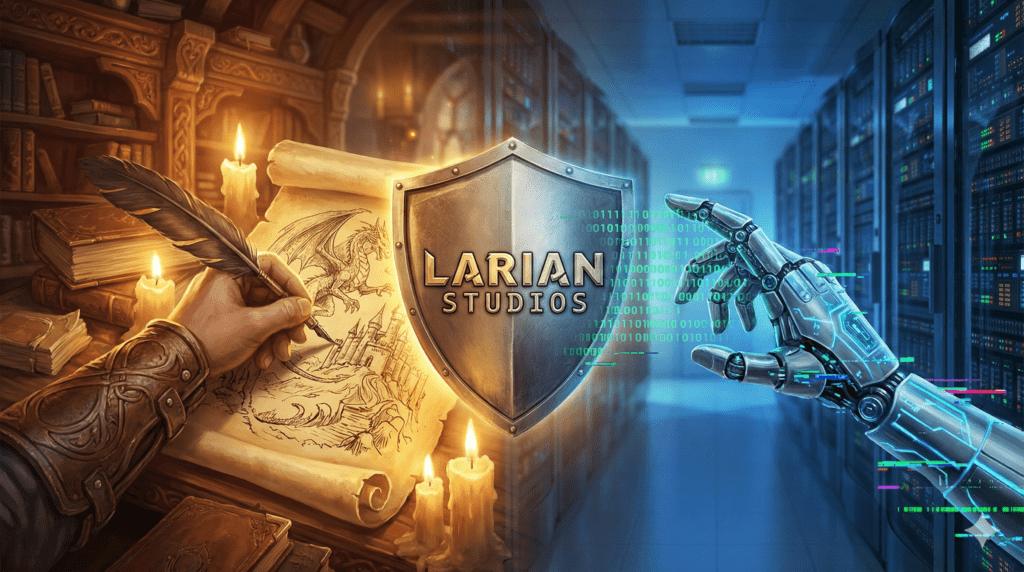
When Larian Studios publicly distanced itself from generative AI, many players misread it as a moral stance. It wasn’t.
It was a design stance.
Larian’s concern was never “AI will replace artists.” Their concern was much simpler and much scarier: AI breaks the internal chain of decisions that makes a game coherent. When writing, level design, combat pacing, and narrative beats stop coming from the same human taste, the game stops feeling intentional — even if every individual part looks fine.
Baldur’s Gate 3 didn’t work because it was large or complex. It worked because thousands of small decisions were aligned by people who knew why they were doing things — even when those decisions were inefficient or risky.
That kind of alignment is fragile.
In practice, AI shatters it.
Clair Obscur: Expedition 33 — The Trust Collapse Moment
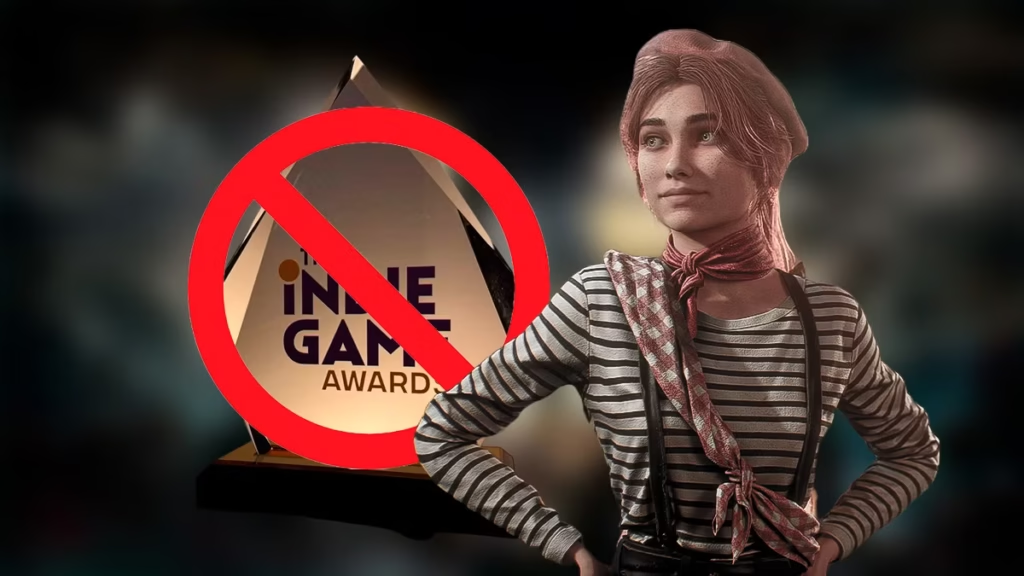
The backlash around Clair Obscur: Expedition 33 didn’t start as outrage.
Instead, it started as suspicion.
Players noticed inconsistencies. Not bugs — vibes. Visual sameness. Textures that felt strangely uniform. Design choices that looked competent but oddly uncommitted. Nothing was wrong, exactly — but nothing felt personal either.
When it later became clear that AI-generated assets were part of the pipeline, the reaction escalated fast. The game being quietly removed or distanced from indie award discussions wasn’t a witch hunt. It was a signal.
What players were reacting to wasn’t AI usage itself.
Rather, it was the feeling of being misled.
Once trust is broken, every design decision gets reinterpreted as laziness instead of intent. And in games, trust is everything.
Why AI Fails at the Actual Job of a Game Designer
Here’s the uncomfortable truth:
Most people misunderstand what game designers actually do.
They don’t just create mechanics.
More importantly, they decide when not to use them.
Good design lives in timing, silence, friction, and imperfection. It’s knowing when a system should feel awkward. When the player should be confused. When boredom is acceptable because tension is coming later.
AI is fundamentally bad at this because it is trained to optimize. It smooths edges. It fills gaps. It avoids failure.
Game designers, on the other hand, constantly make “bad” decisions on purpose. They leave empty spaces. They allow frustration. They break their own rules when the experience demands it.
That kind of judgment is not logical.
Instead, it’s experiential.
AI doesn’t play the game and feel regret.
It doesn’t doubt a decision at 3 a.m.
It doesn’t know when a mechanic technically works but emotionally ruins a scene.
Design lives exactly there.
Why Player Anger Isn’t About Technology at All
If players truly hated AI, they would reject it everywhere. They don’t.
They accept AI-driven upscaling.
They accept procedural animation fixes.
They accept background generation tools.
What players reject, however, is AI pretending to be an author.
The moment AI stops being invisible infrastructure and starts shaping tone, narrative, or identity, players push back. Not because they’re anti-progress, but because games are personal spaces. People invest time, emotion, and memory into them.
Soulless content feels like betrayal.
The Real Pressure Comes From Management, Not Machines
AI isn’t replacing designers.
Instead, studios are trying to do it.
For executives, AI represents speed, cost reduction, and scalability. For players, it represents sameness. That tension is unavoidable.
The danger isn’t that AI will create bad games.
The danger is that it will create acceptable ones — fast, cheap, optimized, and forgettable.
And forgettable is fatal in a medium built on attachment.
What AI Is Actually Good At (And Why That’s Fine)
Used correctly, AI is a powerful assistant.
It’s excellent for prototyping.
It’s useful for iteration.
It helps test variations and fill temporary gaps.
But design doesn’t happen at the beginning of production.
It happens in the moments where someone says, “This technically works — but it feels wrong.”
That moment belongs to humans.
Final Thoughts
AI doesn’t hate games.
It doesn’t love them either.
It doesn’t care if a scene lands emotionally.
It doesn’t feel shame when a system overstays its welcome.
Game designers do.
And as long as games are judged by how they feel — not how efficiently they’re produced — AI will remain what it should be: a tool, not an author.
When studios forget that, players notice.
And they don’t forget.
Related Reads
If this topic resonated with you, you might also be interested in these stories:
- Why Game Studios Like Larian Are Turning to AI (And What It Means for Players)
- Why AAA Veterans Are Abandoning Unreal Engine 5 for Their Own Game Engines
- Players Are Switching to $10–20 Games — And It Makes Sense