
AI Is Not Creative — It Just Feels Creative

Artificial intelligence writes music, paints images, and generates entire stories in seconds — and to many people, that looks like creativity. But scientifically, AI isn’t creative at all. It doesn’t understand what it produces, doesn’t feel emotions, and doesn’t invent new ideas.
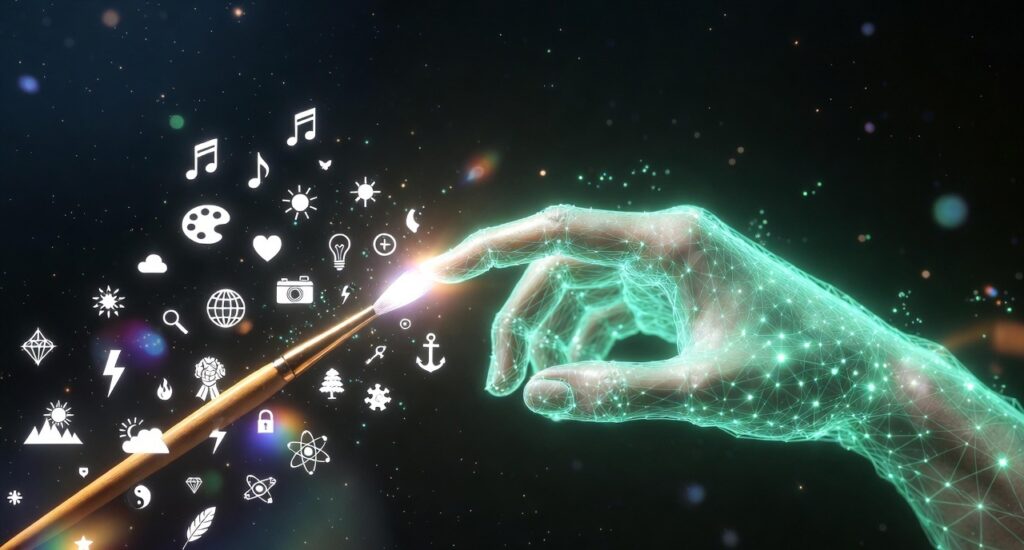
What AI really does is simulate creativity so convincingly that our brains mistake pattern-prediction for imagination. This article explains why that illusion happens, what psychology has to do with it, and why understanding the difference makes AI far more powerful as a creative tool.
Why AI Only Simulates Creativity
At its core, every modern AI system (from ChatGPT to generative image models) is a probability machine.
It doesn’t “think” about meaning — it predicts:
- the most likely next word
- the most likely color or pixel
- the most likely sequence of notes
- or the most likely visual composition
based on patterns in the massive datasets it was trained on.
AI does not create something from nothing. It recombines, averages, and samples patterns from its training data.
In other words:
- AI does not understand emotion — it predicts emotional language.
- AI does not visualize an image — it calculates pixel probabilities.
- AI does not invent stories — it extends patterns of other stories.
This may look like creativity, but the mechanism behind it is statistical, not imaginative.
Canva AI vs Adobe Express vs Figma: Best Design Tool for Non-Designers in 2026?
Why Every Gadget Looks the Same in 2025 — and Why That’s a Problem
Why AI Feels Creative: Psychology Explains It
If AI isn’t creative, then why does it feel so creative to us?
Because the human brain is wired to over-interpret complex outputs — especially when they resemble human work.
Here are the psychological reasons behind the illusion:
1. Anthropomorphism
Humans instinctively project intention onto anything that behaves in a human-like way — even if it’s a machine.
2. Apophenia
We see patterns, meaning, and narrative even in randomness.
When AI gives us something coherent, our brain instantly assumes depth.
3. The Fluency Effect
Smooth sentences or polished images feel “intelligent,” even when they’re algorithmic.
4. The Effort Illusion
Our brain values outcomes that appear instantly.
If AI produces art in 5 seconds, it feels genius-level — not because it is, but because it bypasses effort.
5. The Intent Fallacy
Humans assume that every complex output has an author with a purpose.
AI has no purpose — but the output tricks our brains into thinking otherwise.
Human Creativity vs. AI Output: The Key Difference
Humans create from:
- experience
- emotion
- culture
- intuition
- memory
- imagination
- the desire to express something
Humans break rules, redefine genres, rebel, rethink, reshape, and reinvent.
AI cannot do any of this.
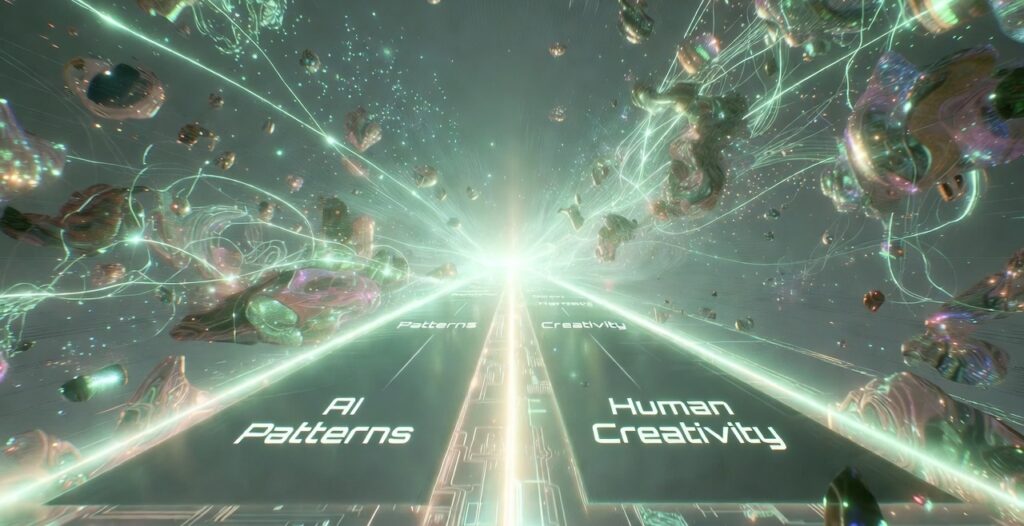
AI recombines. Humans invent.
AI creativity is bounded by its dataset.
Human creativity is bounded only by consciousness.
Why Mistaking AI for a Creative Mind Is Dangerous
The illusion of creativity can lead people to believe AI is smarter than it is — which creates real risks:
⚠️ 1. False Authority
AI can sound confident while being completely wrong.
⚠️ 2. Loss of Critical Thinking
People may trust “creative” outputs without questioning them.
⚠️ 3. Homogenization of Culture
If AI dominates content creation, creative diversity shrinks — everything starts to look the same.
⚠️ 4. Misuse by companies
Businesses may believe AI can replace human creators entirely, leading to shallow, repetitive creative output.
Understanding why AI is not creative is essential to use it responsibly.
Why the Illusion Can Still Be Useful
The truth is: AI doesn’t need to be creative to be powerful.
If you understand its limitations, AI becomes a super-tool that enhances human originality.
✔ Use AI for:
- brainstorming
- generating variations
- exploring styles
- speeding up drafts
- visualizing ideas
- overcoming creative blocks
✔ But keep humans for:
- final expression
- emotional truth
- storytelling
- rule-breaking
- innovation
- taste and vision
AI amplifies creativity — it does not replace it.
Final Thoughts
AI does not imagine or understand.
It does not dream or feel.
It does not create with intent, purpose, or emotion.
But when paired with a human mind, it becomes one of the most powerful creative accelerators in history.
Understanding that AI only simulates creativity is not a limitation — it’s a strength.
It puts humans firmly back in the center of the creative process, using AI as a tool rather than a replacement.
Human creativity is infinite.
AI simply helps us reach it faster.