
Crypto Winter 2026: The Market Didn’t Crash — It Froze

The Ghost of October: The Peak That Still Haunts the Charts
Markets have long memories — and crypto’s memory is brutally visual.
In October 2025, Bitcoin flirted with $126,000, igniting another wave of euphoria. Headlines screamed “new era,” traders chased momentum, and leverage ballooned across derivatives markets.
Then came the unwind.
What followed wasn’t a cinematic single-day crash, but something psychologically worse — a prolonged compression of optimism. By winter 2026, Bitcoin drifted into the $60,000–$67,000 range, effectively halving from its peak.
The ghost of October’s $126k peak still haunts the charts.
Because $60k is not just a price level — it’s a reminder of capital destruction, liquidations, and broken narratives. Every rally attempt now runs into a wall of collective memory.
The $60k Battleground: Why Bulls Lost the Winter
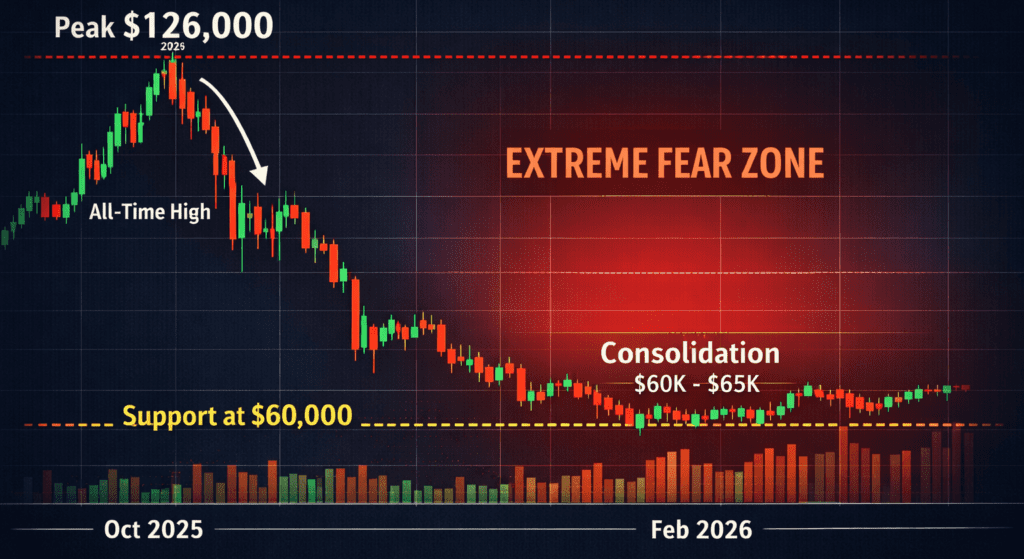
Winter 2026 became a battlefield defined by hesitation rather than panic.
Bitcoin didn’t collapse further — but it couldn’t reclaim bullish structure either. Price action settled into a tight, grinding range, with volatility declining and directional conviction fading.
This kind of market is deceptive.
There is no dramatic capitulation candle. No obvious “bottom.” Just slow erosion of trader confidence:
- Rallies sold into resistance
- Breakouts fading into chop
- Momentum dying prematurely
Bulls didn’t lose in a single fight — they lost through exhaustion.
The Sovereign Holder’s Manifesto: Wallets, Tools, and the Biology of Crypto Success
“The Invisible Ledger”: How Blockchain is Quietly Running the World Outside of Finance in 2026
Capitulation Without Collapse: Why This Winter Feels Different
Unlike prior crypto winters, 2026 lacks a defining catastrophe.
There is no FTX-style implosion, no systemic failure detonating overnight. Instead, the market is experiencing something subtler:
👉 Capitulation through stagnation
Prices freeze. Narratives weaken. Attention drifts.
This is structurally important.
In earlier cycles, fear was explosive. In 2026, fear is ambient — a persistent background condition reflected in sentiment indices hovering near extreme fear.
The market isn’t screaming.
It’s sighing.
The Triple Threat: ETFs, Tariffs, and the Liquidity Trap
Three structural forces quietly defined the winter landscape.
1️⃣ ETF Outflows: When the Bid Became Fragile
Bitcoin ETFs once acted as a stabilizing force, absorbing sell pressure and reinforcing institutional legitimacy.
Winter 2026 told a different story.
Persistent ETF outflows signaled that institutional demand was no longer reflexively supportive. Capital didn’t flee crypto entirely — but flows became selective, defensive, cautious.
Without steady ETF inflows:
✔ upside momentum weakened
✔ liquidity thinned
✔ rallies lost structural backing
2️⃣ Macro Risk-Off: Crypto as a Liquidity Proxy
Crypto’s integration with global markets has matured — but maturity comes with correlation.
Tariff tensions, policy uncertainty, and tightening liquidity conditions reinforced a risk-off regime. In such environments, crypto behaves less like an ideological asset and more like a volatility amplifier.
When macro de-risks:
👉 Crypto de-risks harder.
3️⃣ The Liquidity Trap: Volatility Without Direction
Leverage remains present, but conviction does not.
Derivatives markets continue to generate liquidations, yet these events increasingly produce temporary spikes rather than sustained trends.
This creates a liquidity trap:
✔ traders hesitate
✔ breakouts fail
✔ positioning remains defensive
Where Smart Money Hid During the Freeze
Here’s where winter 2026 becomes genuinely interesting.
Capital didn’t vanish.
It rotated.
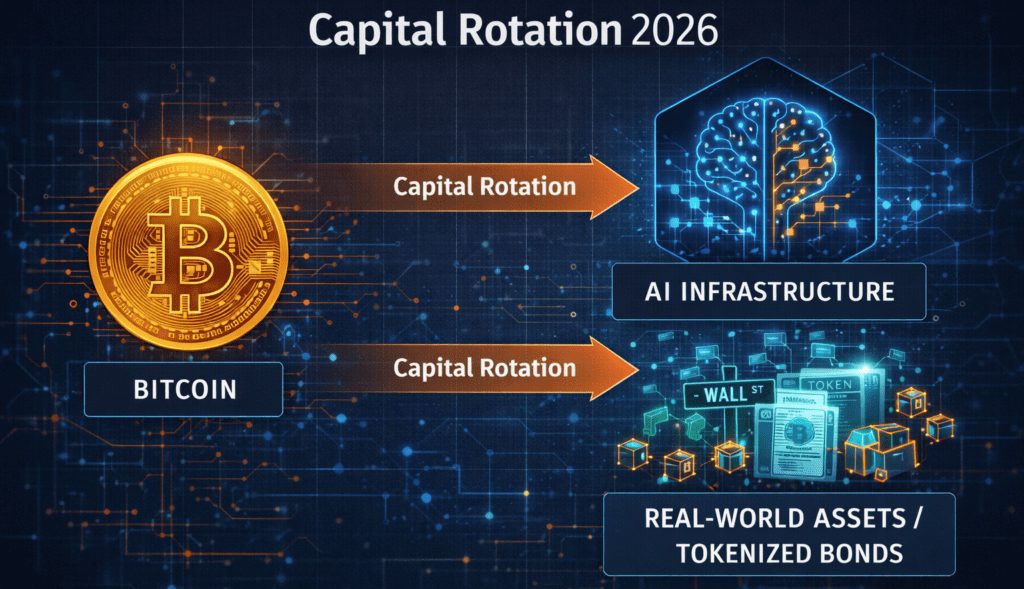
AI Infrastructure: The Narrative That Refused to Die
While speculative mania cooled, AI-crypto convergence retained structural gravity.
Not because of hype alone, but due to deeper themes:
✔ decentralized compute
✔ AI agent economies
✔ verification & ZK integrations
Investors increasingly view AI-aligned protocols as long-duration bets rather than short-term trades.
Even in a frozen market, technological asymmetry attracts capital.
RWA (Real-World Assets): Yield in a Yield-Starved Landscape
Perhaps the most important stabilizing narrative of 2026.
While token prices stagnated, institutions accelerated experimentation with:
✔ tokenized treasuries
✔ on-chain bonds
✔ real-world yield instruments
This shift reframes crypto’s value proposition.
Not just speculation.
👉 Programmable access to traditional yield.
While BTC drifted sideways, the financial plumbing quietly evolved.
The Psychology of a Frozen Market
Crypto winters are rarely defined by charts alone.
They are emotional regimes.
Winter 2026 exhibits a distinct psychological pattern:
✔ fatigue over panic
✔ caution over greed
✔ skepticism over optimism
Retail traders show reduced risk appetite. Institutions display selective engagement. Even volatility feels restrained — as if the market itself is conserving energy.
This environment punishes impulsivity and rewards patience.
Narratives vs. Reality: The Great Market Repricing
One of the defining themes of this cycle:
👉 Narratives are no longer enough
Markets increasingly demand:
✔ revenue models
✔ real usage
✔ sustainable tokenomics
Speculative excess has not disappeared — but it no longer dominates unchallenged.
The market is repricing not just assets, but expectations.
What Could Thaw the Market?
Frozen markets eventually transition — but catalysts matter.
Potential thaw drivers include:
✔ Liquidity Expansion
Crypto remains fundamentally liquidity-sensitive. Any meaningful macro shift toward easing conditions could rapidly alter risk dynamics.
✔ Institutional Reaccumulation
Renewed ETF inflows or large-scale allocation shifts would restore structural bid support.
✔ Narrative-Fundamental Alignment
The most powerful catalyst:
👉 when compelling narratives meet measurable adoption.
AI and RWA sectors are prime candidates.
Final Thoughts: Winter as a Structural Filter
Crypto Winter 2026 is not merely a downturn.
It functions as a filter.
Weak narratives decay. Fragile models collapse. Overleveraged speculation contracts.
What survives tends to matter.
Bitcoin remains range-bound yet structurally dominant. Ethereum continues to anchor infrastructure. AI and RWA themes evolve beneath muted price action.
The market didn’t die.
It froze — forcing participants to distinguish noise from signal.
And historically, frozen markets often precede the most asymmetric opportunities.